Omo remains
Videos
The Omo remains are a collection of hominin bones discovered between 1967 and 1974 at the Omo Kibish sites near the Omo River, in Omo National Park in south-western Ethiopia. The bones were recovered
Reproduction of the head of the Omo hominin in the Musée des Civilisations Noires de Dakar (Sénégal).

The recent African origin of modern humans or the "Out of Africa" theory holds that present-day humans outside Africa descend mainly from a single expansion of anatomically modern humans from Africa a
Omo remains
…List of human fossils Recent African origin of modern humans Analysis of the Huerto remains Archived 2015-12-08 at the Wayback Machine…

Expansion of early modern humans from Africa through the Near East

Layer sequence at Ksar Akil in the Levantine corridor, and discovery of two fossils of Homo sapiens, dated to 40,800 to 39,200 years BP for "Egbert", and 42,400–41,700 BP for "Ethelruda".
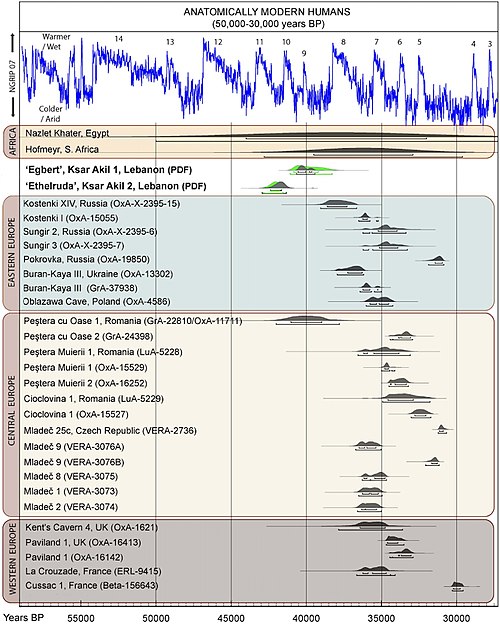
Anatomically Modern Humans known archaeological remains in Europe and Africa, directly dated, calibrated carbon dates as of 2013.

The frontispiece to Huxley's Evidence as to Man's Place in Nature (1863): the image compares the skeleton of a human to other apes.