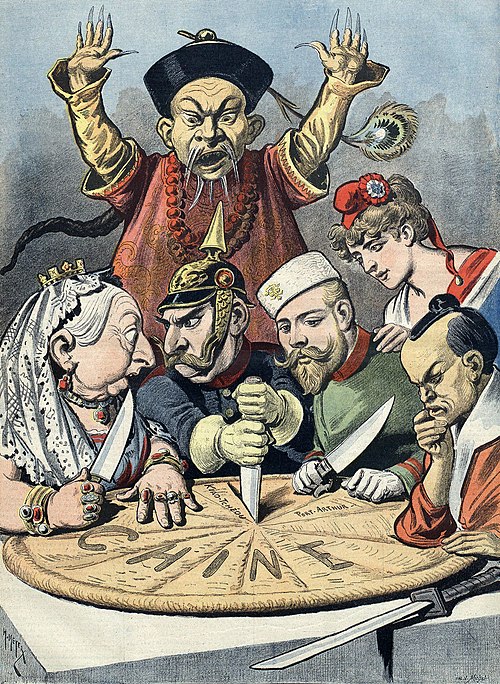
The Open Door Policy is the United States diplomatic policy established in the late 19th and early 20th century that called for a system of equal trade and investment and to guarantee the territorial integrity of Qing China. The policy was created in U.S. Secretary of State John Hay's Open Door Note, dated September 6, 1899, and circulated to the major European powers. In order to prevent the "carving of China like a melon", as they were doing in Africa, the Note asked the powers to keep China open to trade with all countries on an equal basis and called upon all powers, within their spheres of influence to refrain from interfering with any treaty port or any vested interest, to permit Chinese authorities to collect tariffs on an equal basis, and to show no favors to their own nationals in the matter of harbor dues or railroad charges. The policy was accepted only grudgingly, if at all, by the major powers, and it had no legal standing or enforcement mechanism. In July 1900, as the powers contemplated intervention to put down the violently anti-foreign Boxer uprising, Hay circulated a Second Open Door Note affirming the principles. Over the next decades, American policy-makers and national figures continued to refer to the Open Door Policy as a basic doctrine, and Chinese diplomats appealed to it as they sought American support, but critics pointed out that the policy had little practical effect.
US cartoon from 1899: Uncle Sam (center, representing the United States) demanding Open Door access to trade with China while European powers plan to cut it up for themselves. From left to right: Kaiser Wilhelm II (Germany), King Umberto I (Italy), John Bull (Britain), Tsar Nicholas II (Russia) and President Emile Loubet (France). Emperor Franz Joseph I (Austria) is in the back.
Uncle Sam (United States) rejects force and violence and ask "fair field and no favor," equal opportunity for all trading nations to enter the China market peacefully, which became the Open Door Policy. Editorial cartoon by William A. Rogers in Harper's Magazine (New York) November 18, 1899.
Stepping stone to trade to huge China Market, from Judge March 11, 1900
The Chinese economic reform or Chinese economic miracle, also known domestically as reform and opening-up, refers to a variety of economic reforms termed "socialism with Chinese characteristics" and "socialist market economy" in the People's Republic of China (PRC) that began in the late 20th century, after Mao Zedong's death in 1976. Guided by Deng Xiaoping, who is often credited as the "General Architect", the reforms were launched by reformists within the ruling Chinese Communist Party (CCP) on December 18, 1978, during the "Boluan Fanzheng" period. The reforms briefly went into stagnation after the 1989 Tiananmen Square protests and massacre, but were revived after Deng Xiaoping's southern tour in 1992. The reforms led to significant economic growth for China within the successive decades, considered to be one of the economic miracles in human history. In 2010, China overtook Japan as the world's second-largest economy by nominal GDP, before overtaking the United States in 2016 as the world's largest economy by GDP (PPP). On the other hand, a parallel set of political reforms were launched by Deng and his allies in the 1980s, but eventually ended in 1989 due to the crackdown on Tiananmen Square protests, halting further political liberalization.
The image of Deng Xiaoping in Shenzhen, Guangdong, one of the first special economic zones approved by Deng in 1979
Hu Yaobang, then General Secretary of CCP, played an important role in implementing the reforms together with Zhao Ziyang, then Premier of China.
Shenzhen, one of the first special economic zones of China and the "Silicon Valley of China". Notable high-tech companies such as Huawei, ZTE and Konka were all founded in Shenzhen in the 1980s.
The slogan "Time is Money, Efficiency is Life" from Shekou, Shenzhen, representing the "Shenzhen speed"