Open matte
Videos
Open matte is a filming technique that involves matting out the top and bottom of the film frame in the movie projector for the widescreen theatrical release and then scanning the film without a matte
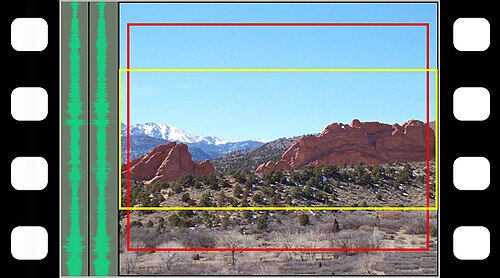
A frame from a 35 mm film print. Here, the picture is framed for the intended theatrical aspect ratio (inside the yellow box). The picture outside of the yellow box is matted out when the film is shown in widescreen. For 4:3 television and home media versions, a large portion of the picture can be used (inside the red box) with an open matte.

Open matte example with a slight shift of the image section upwards

Aspect ratio 2.35:1 versus 1.85:1
IMAX
Videos
IMAX is a proprietary system of high-resolution cameras, film formats, film projectors, and cinemas originally known for having steep stadium seating and very large screens with a tall aspect ratio, t
Open matte
…Willy Wonka & the Chocolate Factory, The Fugitive, Splash, Silverado and Predator, as well as many films that have been specially formatted for the IMAX expanded aspect ratio of 1.90:1 and 1.43:1. Stanley Kubrick also used this technique for his last three films The Shining (1980), Full Metal Jacket…

IMAX projector with horizontal film reel

An IMAX cinema camera, displayed at the National Science and Media Museum, Bradford, United Kingdom

The 15 kW Xenon short-arc lamp used in IMAX film projectors, as seen here, being displayed at the Montreal Science Centre

An entrance to an IMAX digital theater, such as the AMC Barton Creek Square 14 in Austin, Texas