Operation Bodenplatte
Videos
Operation Bodenplatte, launched on 1 January 1945, was an attempt by the German Luftwaffe to cripple Allied air forces in the Low Countries during the Second World War. The goal of Bodenplatte was to

A Fw 190D-9 of 10./JG 54 Grünherz, (pilot Leutnant Theo Nibel), downed by a partridge which flew into the nose radiator near Brussels on 1 January 1945.

Focke-Wulf Fw 190A shot down by a fighter of the USAAF XXIX Tactical Air Command in 1944 or 1945. German losses were very heavy by late 1944.

Destroyed P-47s at Y-34 Metz-Frescaty airfield.

Kurt Tank and Major Günther Specht (left) inspecting the rudder of his Bf 109. Specht's loss was a bitter blow for JG 11.
Luftwaffe
Videos
The Luftwaffe was the aerial-warfare branch of the Wehrmacht before and during World War II. Germany's military air arms during World War I, the Luftstreitkräfte of the Imperial Army and the Marine-Fl
Operation Bodenplatte
…Operation Bodenplatte (; "Baseplate"), launched on 1 January 1945, was an attempt by the German Luftwaffe to cripple Allied air forces in the Low Countries during the Second World War. The goal of Bodenplatte was to gain air superiority during the stagnant…
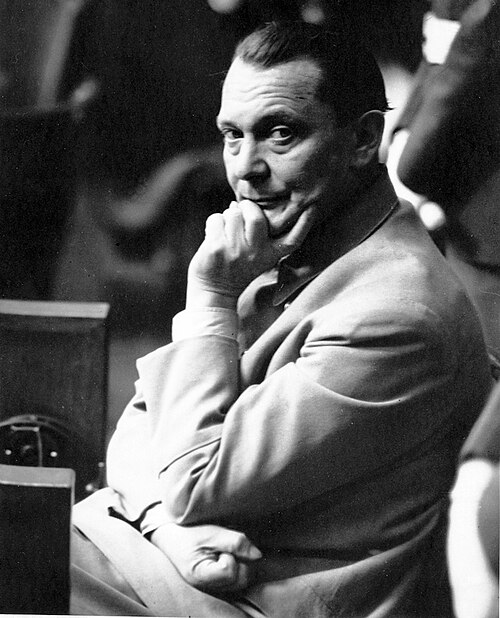
Hermann Göring, the first Supreme Commander of the Luftwaffe (in office: 1935–1945)

Robert Ritter von Greim, the second and last Supreme Commander of the Luftwaffe (in office: April–May 1945)

Manfred von Richthofen with other members of Jasta 11, 1917 as part of the Luftstreitkräfte

Walther Wever, Chief of the Luftwaffe General Staff, 1933–1936