Operational Requirement F.155
Operational Requirement F.155 was a specification issued by the British Ministry of Supply on 15 January 1955 for an interceptor aircraft to defend the United Kingdom from Soviet high-flying nuclear-armed supersonic bombers.
Gloster Javelin all-weather fighter in service at the time.
A projected fighter derivative of Fairey's successful FD2 experimental aircraft
Armstrong-Whitworth AW.169 manufacturer's model
Vickers Type 559
An interceptor aircraft, or simply interceptor, is a type of fighter aircraft designed specifically for the defensive interception role against an attacking enemy aircraft, particularly bombers and reconnaissance aircraft. Aircraft that are capable of being or are employed as both ‘standard’ air superiority fighters and as interceptors are sometimes known as fighter-interceptors. There are two general classes of interceptor: light fighters, designed for high performance over short range; and heavy fighters, which are intended to operate over longer ranges, in contested airspace and adverse meteorological conditions. While the second type was exemplified historically by specialized night fighter and all-weather interceptor designs, the integration of mid-air refueling, satellite navigation, on-board radar and beyond visual range (BVR) missile systems since the 1960s has allowed most frontline fighter designs to fill the roles once reserved for specialised night/all-weather fighters.
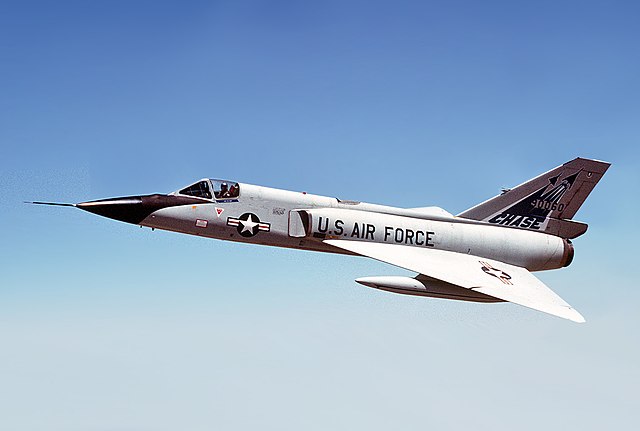
The Convair F-106 Delta Dart, a principal interceptor of the U.S. Air Force in the 1960s, 70s, and 80s
A USAF F-22 Raptor air superiority fighter intercepting a Russian Tu-95 near Alaska
RAF English Electric Lightning point defense interceptor
Mikoyan MiG-31


