Oracle bone
Videos
Oracle bones are pieces of ox scapula and turtle plastron which were used in pyromancy – a form of divination – during the Late Shang period in ancient China. Scapulimancy is the specific term if ox s

A Shang dynasty oracle bone from the Shanghai Museum

Wang Yirong, Chinese politician and scholar, was the first to recognize the oracle bones as ancient writing.

Reconstruction of oracle bone pit YH127 at Yinxu

Ox scapula recording divinations by Zhēng 爭 during the reign of king Wu Ding
Turtle shell
Videos
The turtle shell is a shield for turtles, completely enclosing all the turtle's vital organs and in some cases even the head. It comprises an upper part, the carapace, and lower part, the plastron, co
Oracle bone
…Oracle bones are pieces of ox scapula and turtle plastron which were used in pyromancy – a form of divination – during the Late Shang period (c. 1250 – c. 1050 BCE) in ancient China. Scapulimancy is the specific…

Carapace: Scutes (left) and skeletal components (right).
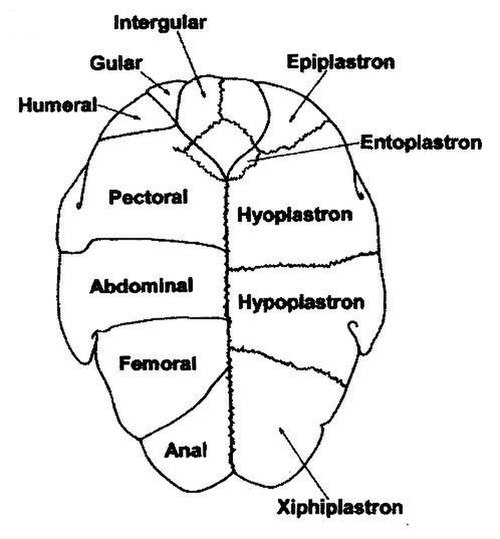
Plastron: Scutes (left) and skeletal components (right). Pleurodires have an extra scute known as the intergular. It is mostly absent in cryptodires.

Internal anterior carapace of Elseya dentata. (Annotations: Pe = peripheral, P1 = pleural 1, BCS = bridge carapace suture.)

Exploded view of the carapace of Emys orbicularis. Legend (i) Neural 1, (ii) Neural 2, (iii) Neural 3, (iv) Neural 4, (v) Neural 5, (vi) Neural 6, (vii) Neural 7, (viii) Neural 8, (ix) extra neural, divided, (x) suprapygal, (xi) nuchal, (xii) right peripheral 1, (xiii) right peripheral 2, (xiv) right peripheral 3, (xv) right peripheral 4, (xvi) right peripheral 5, (xvii) right peripheral 6, (xviii) right peripheral 7, (xix) right peripheral 8, (xx) right peripheral 9, (xxi) right peripheral 10, (xxii) right peripheral 11, (xxiii) pygal, (xxiv) left peripheral 11, (xxv) left peripheral 10, (xxvi) left peripheral 9, (xxvii) left peripheral 8, (xxviii) left peripheral 7, (xxix) left peripheral 6, xxx left peripheral 5, xxxi left peripheral 4, (xxxii) left peripheral 3, (xxxiii) left peripheral 2, (xxxiv) left peripheral 1, (xxxv) right 1st rib, (xxxvi) right pleural 1, (xxxvii) right pleural 2, (xxxviii) right pleural 3, (xxxix) right pleural 4, (xl) right pleural 5, (xli) right pleural 6, (xlii) right pleural 7, (xliii) right pleural 8, (xliv) right 10th rib, (xlv) left 1st rib, (xlvi) left pleural 1, (xlvii) left pleural 2, (xlviii) left pleural 3, (xlix) left pleural 4, (l) left pleural 5, (li) left pleural 6, (lii) left pleural 7, (liii) left pleural 8, (liv) left 10th rib, (9-18) centrums.