Orbital spaceflight
Videos
An orbital spaceflight is a spaceflight in which a spacecraft is placed on a trajectory where it could remain in space for at least one orbit. To do this around the Earth, it must be on a free trajectory which has an altitude at perigee around 80 kilometers (50 mi); this is the boundary of space as defined by NASA, the US Air Force and the FAA. To remain in orbit at this altitude requires an orbital speed of ~7.8 km/s. Orbital speed is slower for higher orbits, but attaining them requires greater delta-v. The Fédération Aéronautique Internationale has established the Kármán line at an altitude of 100 km (62 mi) as a working definition for the boundary between aeronautics and astronautics. This is used because at an altitude of about 100 km (62 mi), as Theodore von Kármán calculated, a vehicle would have to travel faster than orbital velocity to derive sufficient aerodynamic lift from the atmosphere to support itself.
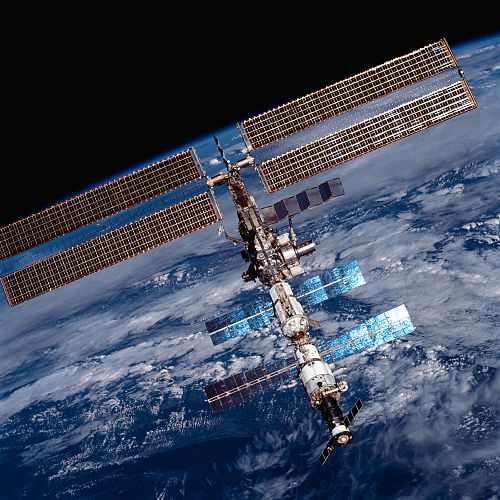
The International Space Station during its construction in Earth orbit in 2001. It must be periodically re-boosted to maintain its orbit
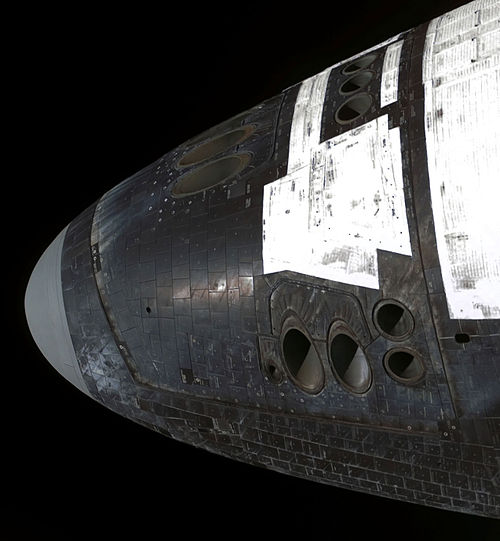
Space Shuttle forward reaction control thrusters
Launch vehicle
Videos
A launch vehicle is typically a rocket-powered vehicle designed to carry a payload from Earth's surface or lower atmosphere to outer space. The most common form is the ballistic missile-shaped multistage rocket, but the term is more general and also encompasses vehicles like the Space Shuttle. Most launch vehicles operate from a launch pad, supported by a launch control center and systems such as vehicle assembly and fueling. Launch vehicles are engineered with advanced aerodynamics and technologies, which contribute to high operating costs.
