Paleolithic religions are a set of spiritual beliefs and practices that are theorized to have appeared during the Paleolithic time period. Paleoanthropologists Andre Leroi-Gourhan and Annette Michelson believe unmistakably religious behavior emerged by the Upper Paleolithic, before 30,000 years ago at the latest, but behavioral patterns such as burial rites that one might characterize as religious — or as ancestral to religious behavior — reach back into the Middle Paleolithic, as early as 300,000 years ago, coinciding with the first appearance of Homo neanderthalensis and possibly Homo naledi.
Reconstructed Australopithecus sediba man
Venus of Berekhat Ram
Incisions in a red ochre fragment from Blombos
Horses found in the Chauvet cave
Behavioral modernity is a suite of behavioral and cognitive traits believed to distinguish current Homo sapiens from other anatomically modern humans, hominins, and primates. Most scholars agree that modern human behavior can be characterized by abstract thinking, planning depth, symbolic behavior, music and dance, exploitation of large game, and blade technology, among others.
Underlying these behaviors and technological innovations are cognitive and cultural foundations that have been documented experimentally and ethnographically by evolutionary and cultural anthropologists. These human universal patterns include cumulative cultural adaptation, social norms, language, and extensive help and cooperation beyond close kin.
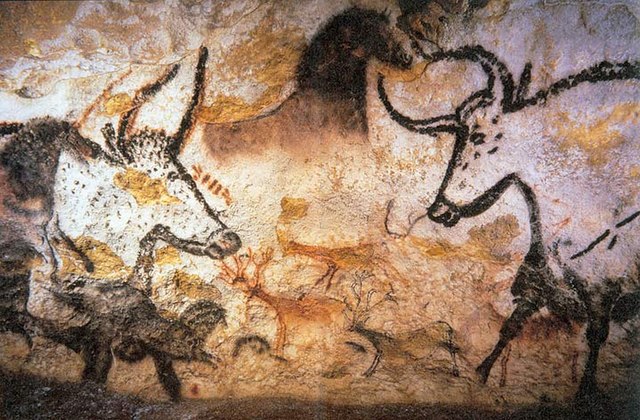
Upper Paleolithic (16,000-year-old) cave painting from Lascaux cave in France
A Māori man performing haka, a ceremonial dance. He is displaying several hallmarks of behavioral modernity including the use of jewelry, application of body paint, music and dance, and symbolic behavior.