Pandeism
Videos
Pandeism, or pan-deism, is a theological doctrine that combines aspects of pantheism with aspects of deism. Unlike classical deism, which holds that the creator deity does not interfere with the universe after its creation, pandeism holds that such an entity became the universe and ceased to exist as a separate entity. Pandeism purports to explain why God would create a universe and then appear to abandon it, and pandeism seeks to explain the origin and purpose of the universe.


Xenophanes of Colophon was considered a pandeist by physicist and philosopher Max Bernhard Weinstein

Giordano Bruno, identified by several sources as a pandeistic thinker

Science fiction writer Robert A. Heinlein was noted as having experimented with themes of pandeism in various of this works.
Bhagavad Gita
Videos
The Bhagavad Gita, often referred to as the Gita, is a 700-verse Hindu scripture, which is part of the epic Mahabharata. It forms the chapters 23–40 of book 6 of the Mahabharata called the Bhishma Parva. The work is dated to the second half of the first millennium BCE.

Bhagavad Gita's revelation: Krishna tells the Gita to Arjuna
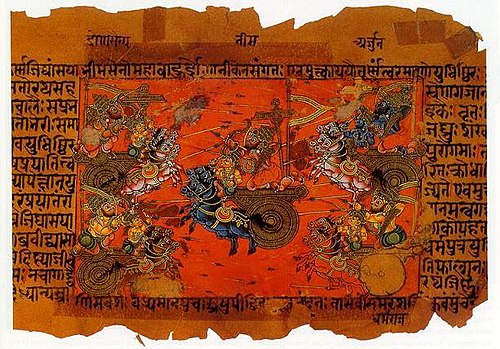
A manuscript illustration of the battle of Kurukshetra, fought between the Kauravas and the Pandavas, recorded in the Mahabharata. c. 1700 – c. 1800 CE

A painting of Krishna recounting Gita to Arjuna during the Kurukshetra War, from the Mahabharata. c. 1820 CE

A didactic print that uses the Gita scene as a focal point for general religious instruction. c. 1960 – c. 1970 CE