The partition of the Ottoman Empire was a geopolitical event that occurred after World War I and the occupation of Constantinople by British, French, and Italian troops in November 1918. The partition
The surrender of Jerusalem to the British on 9 December 1917 after the Battle of Jerusalem


Peace conference memoranda respecting syria arabia palestine 5
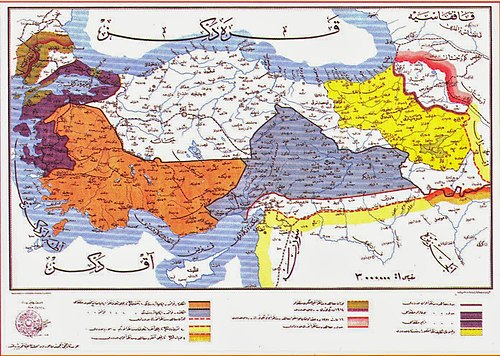
Sevres Ottoman 1927

Paris Peace Conference
Treaty of Sèvres
Videos
The Treaty of Sèvres was a 1920 treaty signed between some of the Allies of World War I and the Ottoman Empire, but not ratified. The treaty would have required the cession of large parts of Ottoman t
Partition of the Ottoman Empire
…Bahrain, and Qatar) and became the Arab States of the Persian Gulf. After the Ottoman government collapsed completely, its representatives signed the Treaty of Sèvres in 1920, which would have partitioned much of the territory of present-day Turkey among France, the United Kingdom, Greece, and Italy. The Turkish War…

Traitedepaix sevres 10081920 webaram

The Ottoman delegation at Sèvres: Left to right: Rıza Tevfik Bölükbaşı, Grand Vizier Damat Ferid Pasha (wearing fez), minister of finance Mehmet Tevfik Biren, and ambassador Reşat Halis

Mehmed Hâdî Pasha signs the Treaty of Sèvres

The First Republic of Armenia, with the western borders defined by US President Woodrow Wilson