Penicillin
Videos
Penicillins are a group of β-lactam antibiotics originally obtained from Penicillium moulds, principally P. chrysogenum and P. rubens. Eight species of Penicillium, in the section Chrysogena, produce

Sample of penicillium mould presented by Alexander Fleming to Douglas Macleod, 1935

Howard Florey (pictured), Alexander Fleming and Ernst Chain shared a Nobel Prize in Physiology or Medicine in 1945 for their work on penicillin.

A lab technician spraying penicillin mould into flasks of corn steep liquor, England, 1943

A World War II-era poster from a construction site for a penicillin factory. A military grave emphasizes the site's importance, as penicillin was urgently needed in wartime.
Alexander Fleming
Videos
Sir Alexander Fleming was a Scottish physician and microbiologist. He shared the 1945 Nobel Prize in Physiology or Medicine with Howard Florey and Ernst Chain "for the discovery of penicillin and its
Penicillin
…another group of β-lactam) because the immunoglobulin E (IgE) cross-reactivity is only 3%. Penicillin was discovered in 1928 by the Scottish physician Alexander Fleming as a crude extract of P. rubens. Fleming's student Cecil George Paine was the first to successfully use penicillin to treat eye infection (neonatal…
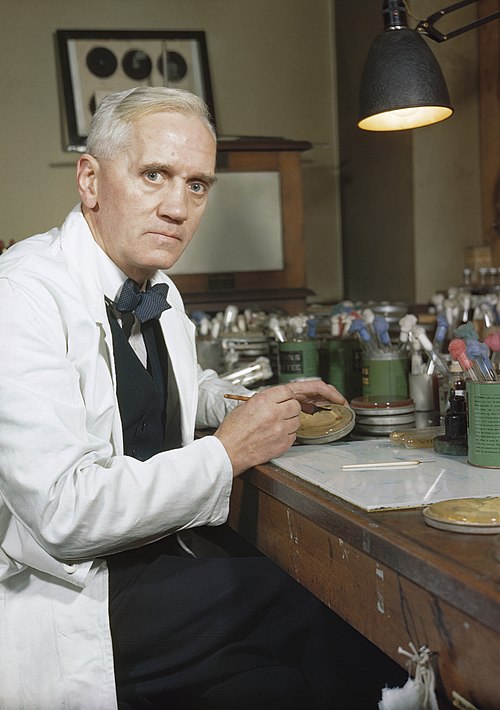
Fleming in his laboratory, 1943

An advertisement advertising penicillin's "miracle cure"

A commemorative plaque marking Fleming's discovery of penicillin at St Mary's Hospital, London

Fleming in his laboratory in 1943