Philipp Veit
Videos
Philipp Veit was a German Romantic painter and one of the main exponents of the Nazarene movement. It is to Veit that the credit of having been the first to revive the nearly forgotten technique of fr
Self portrait, 1816


The Empyreum and Figures of the Celestial Spheres of Paradiso after Dante's Divine Comedy, Casino Massimo, Rome, fresco, 1817–1827

Paradiso, Canto III: Dante and Beatrice speak to Piccarda and Constance of Sicily, detail, Casino Massimo, Rome, fresco, 1817–1827

Franz Ludwig Catel, Crown Prince Ludwig in the Spanish Tavern in Rome, 1824
Germania is the name of a painting that was probably created in March 1848. It hung in the St. Paul's Church in Frankfurt, Germany. At that time, first the so-called Pre-Parliament and then the Frankf
Philipp Veit
…frescoes Die Einführung der Künste durch das Christentum in Deutschland (The Arts Being Introduced to Germany by Christianity) with the allegories of Germania and Italia. Originally, the three-parted fresco adorned the old premises of the Institute in Neue Mainzer Straße. Actually, it displays a conversion…

Germania, painted in 1848

Frankfurt Parliament meeting in the Paulskirche decorated with the painting in 1848–49 (coloured, contemporary engraving). The yellow color on the flag is of contemporary imagination.
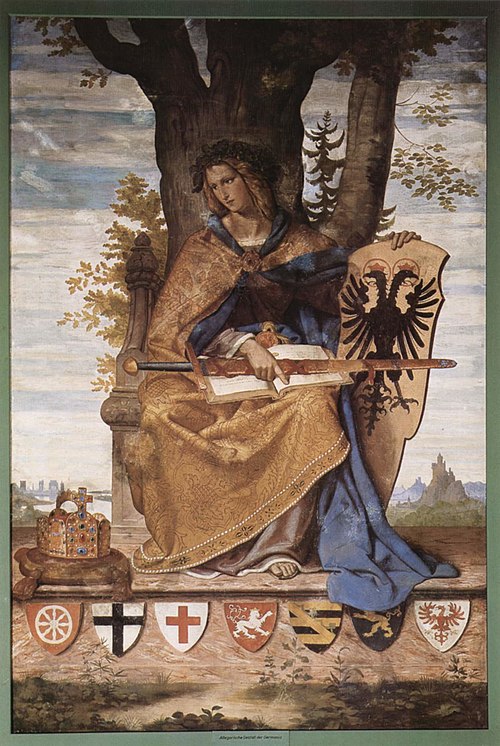
''Germania'' by Philipp Veit, 1836

The original, present-day exhibition in Nuremberg