Pliny the Elder
Videos
Gaius Plinius Secundus, known in English as Pliny the Elder, was a Roman author, naturalist, scientist, naval and army commander of the early Roman Empire, procurator, and friend of the emperor Vespas
19th-century portrait of Pliny the Elder


One of the Xanten Horse-Phalerae located in the British Museum, measuring 10.5 cm (4.1 in). It bears an inscription formed from punched dots: PLINIO PRAEF EQ; i.e., Plinio praefecto equitum, "Pliny prefect of cavalry". It was perhaps issued to every man in Pliny's unit. The figure is the bust of the emperor.

City and Lake of Como, painted by Jean-Baptiste-Camille Corot, 1834

Colossal head of Titus, son of Vespasian. Glyptothek, Munich
Natural History (Pliny)
Videos
The Natural History is a Latin work by Pliny the Elder. The largest single work to have survived from the Roman Empire to the modern day, the Natural History compiles information gleaned from other an
Pliny the Elder
…naturalist, scientist, naval and army commander of the early Roman Empire, procurator, and friend of the emperor Vespasian. Pliny wrote the encyclopedic Naturalis Historia (Natural History), a thirty-seven-volume work covering a vast array of topics on human knowledge and the natural world, which became an editorial model…
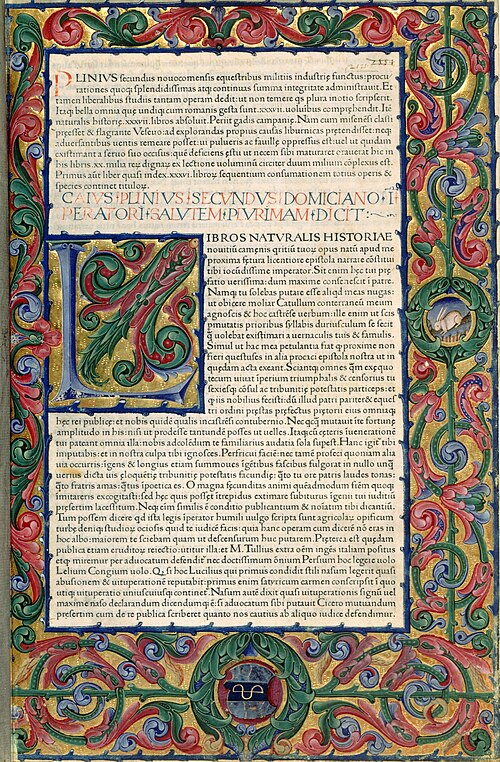
First page from the editio princeps of the Naturalis historia, printed in 1469 in Venice by Johann of Speyer. Bibliothèque nationale de France.

Copy of Naturalis Historia printed by Johannes Alvisius in 1499 in Venice, Italy

A cynocephalus, or dog-head, as described by Pliny in his Natural History. From the Nuremberg Chronicle (1493).

A sciapod, described by Pliny in his Natural History, from the Nuremberg Chronicle (1493)