The Polish–Ukrainian War, from November 1918 to July 1919, was a conflict between the Second Polish Republic and Ukrainian forces.
Polish–Ukrainian and Polish–Soviet Wars early 1919.
"Lwów Eaglets – the defence of the cemetery" by Wojciech Kossak (1926). Oil on canvas, Polish Army Museum, Warsaw. A painting depicting Polish youths in the Battle of Lemberg (1918) (in Polish historiography called the Defense of Lwów) against the West Ukrainian People's Republic proclaimed in Lviv.
Final stage of the Polish–Ukrainian War.
Dmytro Vitovsky, first commander of the Ukrainian Galician Army, flanked by two officers, 1918.
The Second Polish Republic, at the time officially known as the Republic of Poland, was a country in Central and Eastern Europe that existed between 7 October 1918 and 6 October 1939. The state was established in the final stage of World War I. The Second Republic ceased to exist in 1939, after Poland was invaded by Nazi Germany, the Soviet Union, and the Slovak Republic, marking the beginning of the European theatre of the Second World War. The Polish government-in-exile was established in Paris and later London after the fall of France in 1940.
Polish defences at Miłosna, during the decisive Battle of Warsaw, August 1920
Marshal Józef Piłsudski, Chief of State (Naczelnik Państwa) between November 1918 and December 1922
The May Coup d'État (1926)
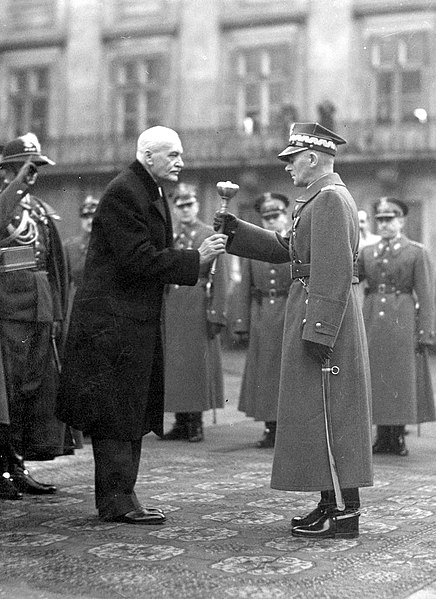
Ignacy Mościcki, President of Poland (left), Warsaw, 10 November 1936, awarding the Marshal's buława to Edward Rydz-Śmigły