In Poland, the resistance movement during World War II was led by the Home Army. The Polish resistance is notable among others for disrupting German supply lines to the Eastern Front, and providing in

Sequentially from top: soldiers from Kolegium "A" of Kedyw on Stawki Street in Wola district, during the Warsaw Uprising, 1944; Jewish prisoners of Gęsiówka concentration camp liberated by Polish Home Army soldiers from "Zośka" Battalion, 5 August 1944; Polish partisans of "Jędrusie" unit in Kielce area, 1945; Old Town of Warsaw in flames during Warsaw Uprising
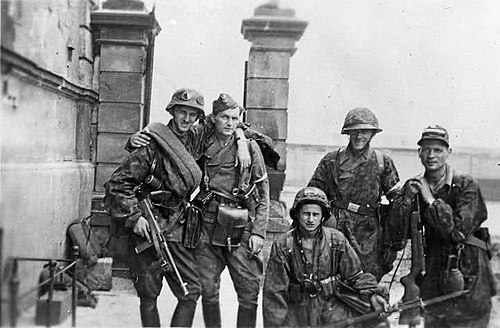
Warsaw Uprising by Deczkowki Kolegium A 15861

Jewish prisones of KZ Gesiowka liberated by Polish Soldiers of Home Army Warsaw 1944

Warsaw 1944
Henryk Dobrzański
Videos
Major Henryk Dobrzański, also known by his nom-de-guerre "Hubal," was a Polish soldier, sportsman and partisan. He fought in the Polish Legions in World War I, Polish–Ukrainian War of 1918, the Polish
Polish resistance movement in World War II
…known as the Home Army (Armia Krajowa). In March 1940, a partisan unit of the first guerrilla commanders in the Second World War in Europe under Major Henryk Dobrzański "Hubal" destroyed a battalion of German infantry in a skirmish near the village of Huciska. A few days later in an ambush near the village of Szałasy it inflicted…

Hubal portretowe big

Hubal

Hubal and his partisan unit, winter 1939

Hubal and his partisan unit, winter 1939