During World War II, resistance movements operated in German-occupied Europe by a variety of means, ranging from non-cooperation to propaganda, hiding crashed pilots and even to outright warfare and t

The first partisan of World War II Hubal and his unit in Poland in winter 1939

A 1941 Soviet poster, inviting disruption of the enemy rear and active resistance at the German-occupied territories

Belorussia, 1943. A Jewish partisan group of the Chkalov Brigade

Ukrainian Insurgent Army in December 1943
In Poland, the resistance movement during World War II was led by the Home Army. The Polish resistance is notable among others for disrupting German supply lines to the Eastern Front, and providing in

Sequentially from top: soldiers from Kolegium "A" of Kedyw on Stawki Street in Wola district, during the Warsaw Uprising, 1944; Jewish prisoners of Gęsiówka concentration camp liberated by Polish Home Army soldiers from "Zośka" Battalion, 5 August 1944; Polish partisans of "Jędrusie" unit in Kielce area, 1945; Old Town of Warsaw in flames during Warsaw Uprising
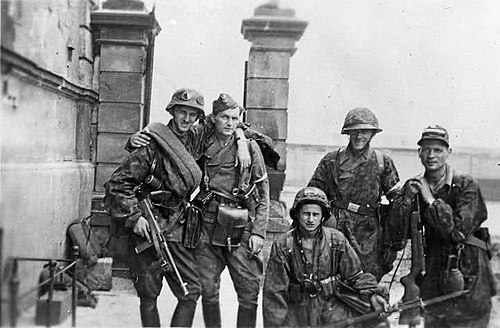
Warsaw Uprising by Deczkowki Kolegium A 15861

Jewish prisones of KZ Gesiowka liberated by Polish Soldiers of Home Army Warsaw 1944

Warsaw 1944