Priyadasi
Videos
Priyadasi, also Piyadasi or Priyadarshi, was the imperial title used by the Mauryan Emperor Ashoka Maurya ; literally an honorific epithet which means "He who regards others with kindness", "Humane",

"Piyadasi", honorific epithet of Ashoka, in Brahmi script, in the Barabar Caves.

Piyadasi in the Lumbini Minor Pillar Edict of Ashoka.

"Devānaṃpiyasa Asoka", honorific Devanampiya (Brahmi script: 𑀤𑁂𑀯𑀸𑀦𑀁𑀧𑀺𑀬𑀲𑀅𑀲𑁄𑀓, "Beloved of the God", in the adjectival form -sa) and name of Ashoka, in Brahmi script, in the Maski Edict of Ashoka

Major Rock Edicts and Major Pillar Edicts by Devanampiya Piyadasi
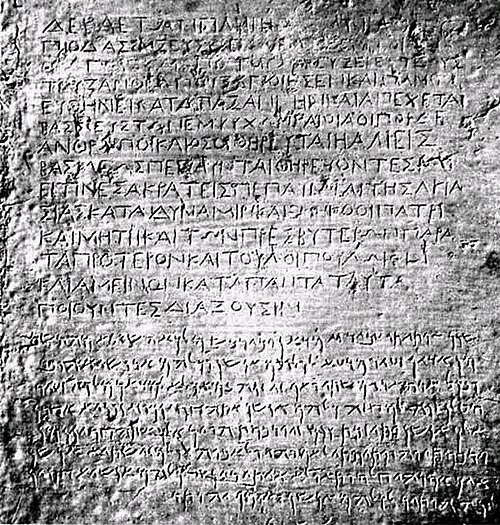
The Kandahar Bilingual Rock Inscription, also known as the Kandahar Edict of Ashoka and less commonly as the Chehel Zina Edict, is an inscription in the Greek and Aramaic languages that dates back to
Bilingual inscription of Ashoka in Greek (top) and Aramaic (bottom) in Afghanistan

Chil Zena ("40 steps") complex, offering a commanding view of Kandahar, and on the mountainside of which the bilingual edict is carved. Chil Zena commands the entrance to the city of Kandahar when coming from the west.

The Kandahar Bilingual Rock Inscription was located at the edge of the Indian realm, near the border with the Greco-Bactrian kingdom and Ai-Khanoum.

An 1881 photo showing the ruined Old Kandahar citadel ("Zor Shar") where the second Greek edict was discovered.