Prometheus (moon)
Videos
Prometheus is an inner satellite of Saturn. It was discovered on 24 October 1980 from images taken by the Voyager 1 probe, and was provisionally designated S/1980 S 27. In late 1985 it was officially

Prometheus image from Cassini (December 26, 2009)

Prometheus pulling material from the F Ring

Prometheus tugging kinks into the F Ring

Cassini image (with moon's Saturn-facing end at lower right) reveals a surface covered with a blanket of fine material.
Rings of Saturn
Videos
Saturn has the most extensive and complex ring system of any planet in the Solar System. The rings consist of particles in orbit around the planet, ranging from micrometers to meters in size, and are
Prometheus (moon)
…relatively high albedo, it is likely that Prometheus is a very porous icy body. Prometheus is a shepherd satellite for the inner edge of Saturn's narrow F Ring. Pandora orbits just outside the F Ring, and has traditionally been viewed as an outer shepherd of the ring; however, recent studies indicate that only…

The full set of rings, imaged on 19 July 2013, as Saturn eclipses the Sun from the vantage of the Cassini orbiter, which is 1.2 million kilometres (0.75 million miles) from Saturn. Earth appears as a dot at 5 o'clock, between the G and E rings – with its brightness artificially exaggerated in this photograph.
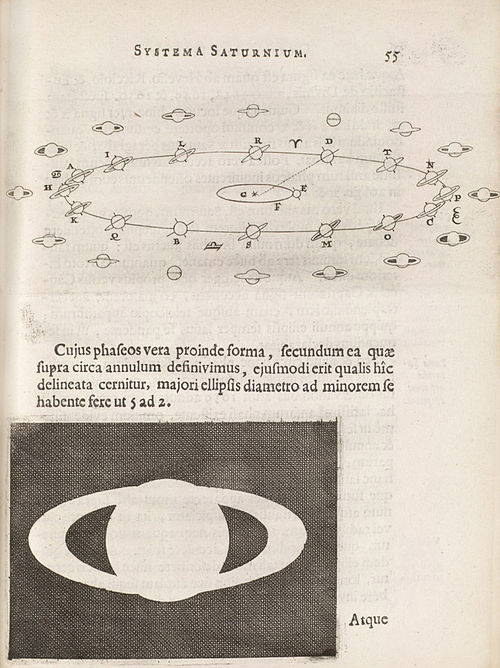
Huygens' ring hypothesis in Systema Saturnium (1659)

Simulated image using color to present radio-occultation-derived particle size data. The attenuation of 0.94-, 3.6-, and 13-cm signals sent by Cassini through the rings to Earth shows abundance of particles of sizes similar to or larger than those wavelengths. Purple (B, inner A Ring) means few particles are < 5 cm (all signals similarly attenuated). Green and blue (C, outer A Ring) mean particles < 5 cm and < 1 cm, respectively, are common. White areas (B Ring) are too dense to transmit adequate signal. Other evidence shows rings A to C have a broad range of particle sizes, up to m across.

Cassini space probe view of the unilluminated side of Saturn's rings (October 10, 2013).