Promoter (genetics)
Videos
In genetics, a promoter is a sequence of DNA to which proteins bind to initiate transcription of a single RNA transcript from the DNA downstream of the promoter. The RNA transcript may encode a protei
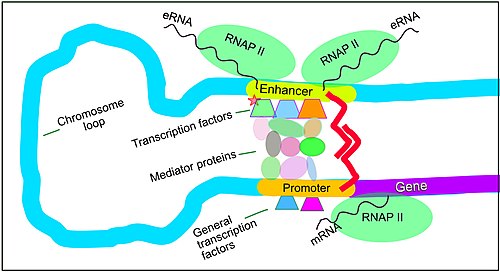
Regulation of transcription in mammals. An active enhancer regulatory region is enabled to interact with the promoter region of its target gene by formation of a chromosome loop. This can initiate messenger RNA (mRNA) synthesis by RNA polymerase II (RNAP II) bound to the promoter at the transcription start site of the gene. The loop is stabilized by one architectural protein anchored to the enhancer and one anchored to the promoter and these proteins are joined to form a dimer (red zigzags). Specific regulatory
RNA polymerase
Videos
In molecular biology, RNA polymerase, or more specifically DNA-directed/dependent RNA polymerase, is an enzyme that catalyzes the chemical reactions that synthesize RNA from a DNA template strand.
Promoter (genetics)
…Promoters can be about 100–1000 base pairs long, the sequence of which is highly dependent on the gene and product of transcription, type or class of RNA polymerase recruited to the site, and species of organism. For transcription to take place, the enzyme that synthesizes RNA, known as RNA polymerase, must attach…

RNA polymerase hetero 27-mer, human

An electron-micrograph of DNA strands decorated by hundreds of RNAP molecules too small to be resolved. Each RNAP is transcribing an RNA strand, which can be seen branching off from the DNA. "Begin" indicates the 3′ end of the DNA, where RNAP initiates transcription; "End" indicates the 5′ end, where the longer RNA molecules are completely transcribed.

RNAP from T. aquaticus pictured during elongation. Portions of the enzyme were made transparent so as to make the path of RNA and DNA more clear. The magnesium ion (yellow) is located at the enzyme active site.

T7 RNA polymerase producing a mRNA (green) from a DNA template. The protein is shown as a purple ribbon (PDB: 1MSW)