Pschent
Videos
The pschent was the double crown worn by rulers in ancient Egypt. The ancient Egyptians generally referred to it as Pa-sekhemty, the Two Powerful Ones, from which the Greek term is derived. It combine

Fragment of an ivory label showing pharaoh Den wearing the double crown of Upper and Lower Egypt. Discovered in the tomb of Den at Umm El Qa'ab, now in the Egyptian Museum

Pharaoh Ptolemy VIII between the goddesses Wadjet (symbolizing lower Egypt) and Nekhbet (symbolizing upper Egypt). Bas-relief on wall of Temple of Edfu, Egypt

Ring of Ptolemy VI Philometor wearing the Pschent Double Crown, 3rd to 2nd Century BC. Ptolemaic rulers wore the Pschent in Egypt only and wore the Greek diadem in the other territories

Statue head Senusret III wearing a pschent
Deshret
Videos
Deshret was the Red Crown of Lower Egypt. It was a red bowl shaped with a protruding curlicue. When combined with the Hedjet of Upper Egypt, it forms the Pschent, in ancient Egyptian called the sekhem
Pschent
…it as Pa-sekhemty (pꜣ-sḫm.ty), the Two Powerful Ones, from which the Greek term is derived. It combined the White Hedjet Crown of Upper Egypt and the Red Deshret Crown of Lower Egypt. The Pschent represented the pharaoh's power over all of unified Egypt. It bore two animal emblems: an Egyptian cobra, known as the…

Vase fragment with earliest known depiction of a Red Crown. Naqada IIA, circa 3600 BC, Ashmolean Museum.

Limestone head of an early Egyptian king, The Petrie Museum. Modern scholars have considered the stone bust to depict an Early Dynastic or Old Kingdom pharaoh, wearing the Deshret crown..

Rosetta Stone usage of Red Crown, not as preposition: part of Pschent (Double Crown), and part of "Taui", the name for Upper and Lower Egypt (used combined with a Crossroads (hieroglyph))
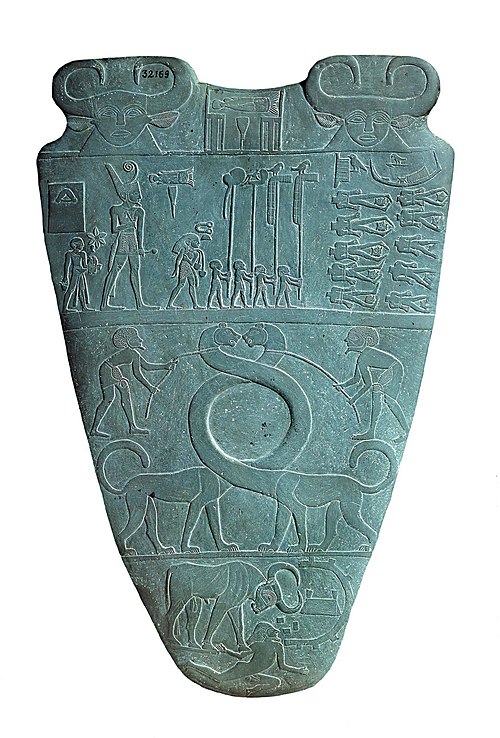
Narmer Palette, front