Quadrant (instrument)
Videos
A quadrant is an instrument used to measure angles up to 90°. Different versions of this instrument could be used to calculate various readings, such as longitude, latitude, and time of day. It was fi
A large frame quadrant at the Beijing Ancient Observatory. It was constructed in 1673.


Ptolemy using a quadrant

A quadrant in a Turkish illustration

Engraving of Tycho Brahe's Mural quadrant in Uraniborg in 1598, picturing the two clocks.
Astrolabe
Videos
An astrolabe is an astronomical instrument dating to ancient times. It serves as a star chart and physical model of the visible half-dome of the sky. Its various functions also make it an elaborate in
Quadrant (instrument)
…instrument could be used to calculate various readings, such as longitude, latitude, and time of day. It was first proposed by Ptolemy as a better kind of astrolabe. Several different variations of the instrument were later produced by medieval Muslim astronomers. Mural quadrants were important astronomical instruments…

North African, 9th century ce, planispheric astrolabe. Khalili Collection.
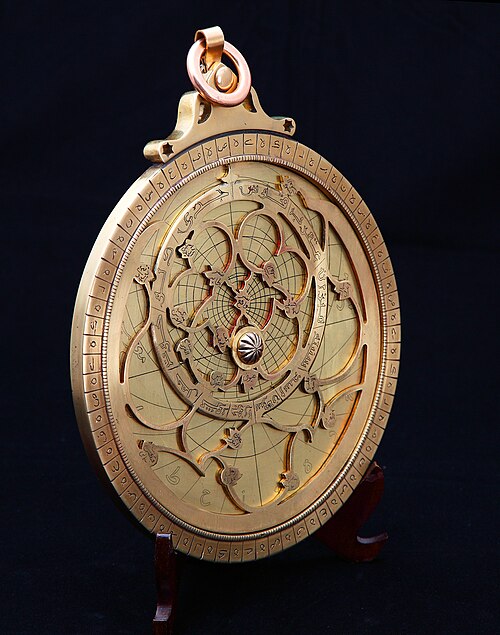
A modern astrolabe made in 2013, in Tabriz, Iran.

16th-century woodcut of the measurement of a building's height with an astrolabe

A modern reconstruction of the spherical astrolabe of Ptolemy, 2nd C.E., in Kotsanas Museum of Ancient Greek Technology, Athens.