Radio broadcasting
Videos
Radio broadcasting is the transmission of signals, especially audio, to receivers using radio waves over a wide area. Listeners require a broadcast radio receiver to receive these signals. "Terrestria
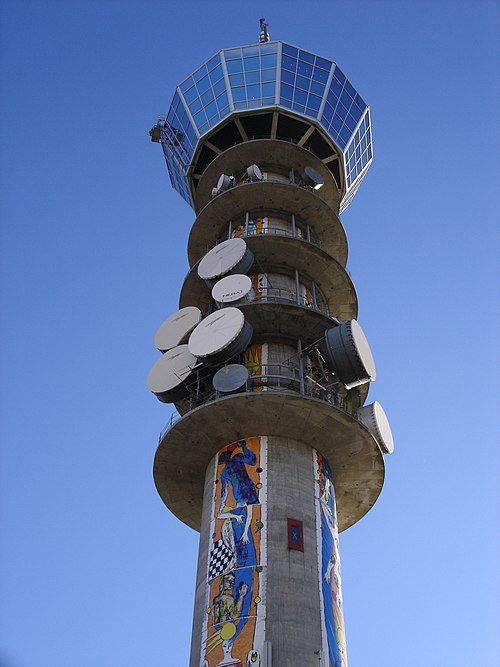
Broadcasting tower in Trondheim, Norway

Charles Logwood broadcasting at 2XG in New York City in 1916.
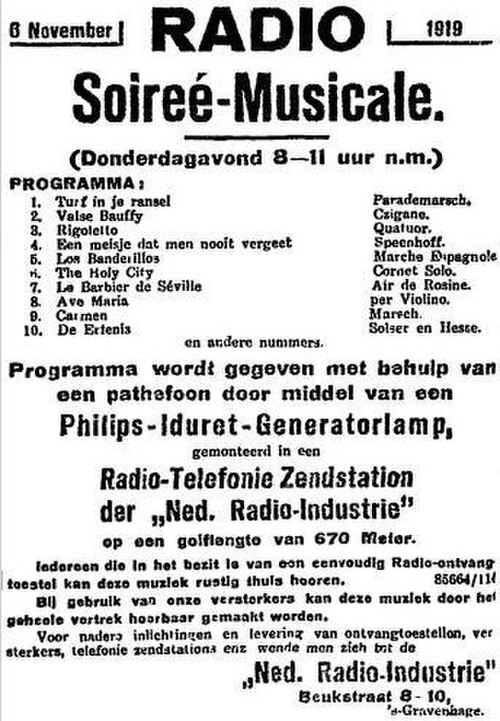
November 5, 1919 Nieuwe Rotterdamsche Courant advertisement, announcing PCGG's debut broadcast scheduled for the next evening, using narrow-band frequency modulation (FM).

Control room and radio studio of the Finnish broadcasting company Yleisradio (YLE) in the 1930s.
AM broadcasting
Videos
AM broadcasting is radio broadcasting using amplitude modulation transmissions. It was the first method developed for making audio radio transmissions, and is still used worldwide, primarily for mediu
Radio broadcasting
…station shall be classified by the service in which it operates permanently or temporarily. Broadcasting by radio takes several forms. These include AM and FM stations. There are several subtypes, namely commercial broadcasting, non-commercial educational (NCE) public broadcasting and non-profit varieties…

Lee de Forest used an early vacuum-tube transmitter to broadcast returns for the Hughes-Wilson presidential election returns on November 7, 1916, over 2XG in New York City. Pictured is engineer Charles Logwood.

Nellie Melba making a broadcast over the Marconi Chelmsford Works radio station in England on June 15, 1920.

Farmer listening to U.S. government weather and crop reports using a crystal radio in 1923. Public service government time, weather, and farm broadcasts were the first radio "broadcasts".

1938 Zenith Model 12-S vacuum-tube console radio, capable of picking up mediumwave and shortwave AM transmissions. "All Wave" receivers could also pick up the third AM band: longwave (LW).