Radiodonta
Videos
Radiodonta is an extinct order of stem-group arthropods that was successful worldwide during the Cambrian period. Radiodonts are distinguished by their distinctive frontal appendages, which are morpho

Preserved compound eyes of Anomalocaris (top, F-H) and Echidnacaris (bottom, I-K), showing preserved individual ommatidia lenses. The density of the lenses in Anomalocaris is comparable to that of living dragonflies. Scale bar = 5 mm in F, G, I, J 0.3 mm in H and 1 mm in K

Reconstruction of Shucaris, an anomalocaridid or amplectobeluiid radiodont, using its frontal appendages to capture a fleeing Erratus
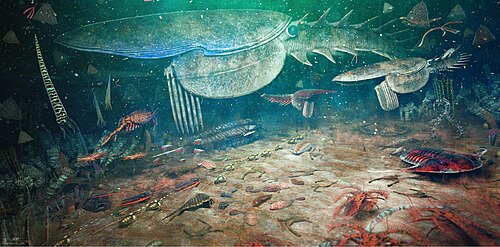
Reconstruction of the Fezouata Biota, featuring Aegirocassis, a filter feeding radiodont, and two species of Pseudoangustidontus

Body specimen of Peytoia nathorsti, the original "Laggania cambria"
Cambrian
Videos
The Cambrian is the first geological period of the Paleozoic Era and the Phanerozoic Eon. The Cambrian lasted 51.95 million years from the end of the preceding Ediacaran period 538.8 Ma to the beginni
Radiodonta
…Radiodonta is an extinct order of stem-group arthropods that was successful worldwide during the Cambrian period. Radiodonts are distinguished by their distinctive frontal appendages, which are morphologically diverse and were used for a variety of functions…

Ediacaran–Cambrian boundary section at Fortune Head, Newfoundland, GSSP

Diorama of the Burgess Shale Biota

Archeocyathids from the Poleta formation in the Death Valley area
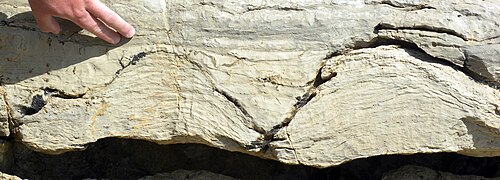
Stromatolites of the Pika Formation (Middle Cambrian) near Helen Lake, Banff National Park, Canada