Rassenschande
Videos
Rassenschande or Blutschande was an anti-miscegenation concept in Nazi German racial policy, pertaining to sexual relations between Aryans and non-Aryans. It was put into practice by policies like the
Reich Citizenship Law (Reichsbürgergesetz) for the Protection of German Blood and German Honor, adopted unanimously by the Reichstag on 15 September 1935


A meeting of the four Nazis who imposed Nazi ideology on the legal system of Germany. From left to right: Roland Freisler, Franz Schlegelberger, Otto Georg Thierack, and Curt Rothenberger.

Stolperstein for Walenty Piotrowski and Franciszek Wysocki, Polish forced laborers hanged for Rassenschande on 18 June 1941
Nuremberg Laws
Videos
The Nuremberg Laws were antisemitic and racist laws introduced in Nazi Germany on 15 September 1935 at a special session of the Reichstag during the annual Nuremberg Rally of the Nazi Party. The legis
Rassenschande
…Aryans and non-Aryans. It was put into practice by policies like the Aryan certificate requirement, and later by anti-miscegenation laws such as the Nuremberg Laws, adopted unanimously by the Reichstag on 15 September 1935. Initially, these laws referred predominantly to relations between ethnic Germans (classified…
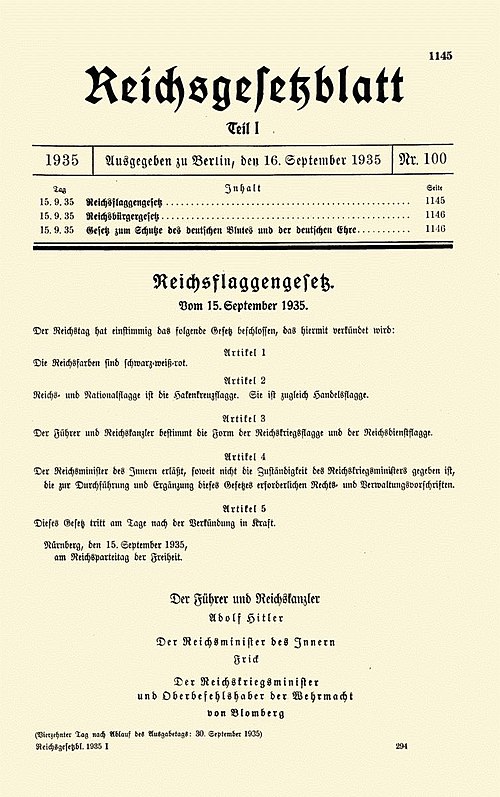
Title page of the German government gazette Reichsgesetzblatt issue proclaiming the laws, published on 16 September 1935 (RGBl. I No. 100)
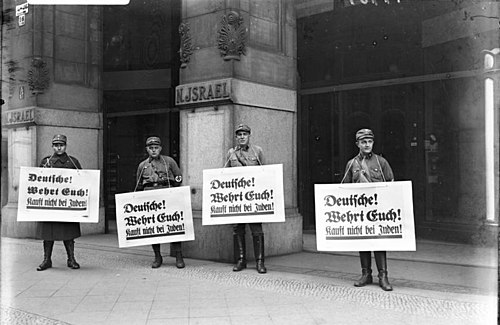
Members of the SA picketing in front of a Jewish place of business with placards saying "Germans! Defend yourselves! Don't buy from Jews!" during the Nazi boycott of Jewish businesses, 1 April 1933

The SA had nearly three million members at the start of 1934.