Redaction
Videos
Redaction or sanitization is the process of removing sensitive information from a document so that it may be distributed to a broader audience. It is intended to allow the selective disclosure of information. Typically, the result is a document that is suitable for publication or for dissemination to others rather than the intended audience of the original document.


A heavily redacted page from a 2004 lawsuit filed by the ACLU — American Civil Liberties Union v. Ashcroft
![A page of a classified document that has been sanitized for public release. This is page 13 of a U.S. National Security Agency report [1] Archived 200](https://upload.wikimedia.org/wikipedia/commons/thumb/5/54/NSALibertyReport.p13.jpg/500px-NSALibertyReport.p13.jpg)
A page of a classified document that has been sanitized for public release. This is page 13 of a U.S. National Security Agency report [1] Archived 2004-03-13 at the Wayback Machine on the USS Liberty incident, which was declassified and released to the public in July 2003. Classified information has been blocked out so that only the unclassified information is visible. Notations with leader lines at top and bottom cite statutory authority for not declassifying certain sections. Click on the image to enlarge.
Data remanence
Videos
Data remanence is the residual representation of digital data that remains even after attempts have been made to remove or erase the data. This residue may result from data being left intact by a nominal file deletion operation, by reformatting of storage media that does not remove data previously written to the media, or through physical properties of the storage media that allow previously written data to be recovered. Data remanence may make inadvertent disclosure of sensitive information possible should the storage media be released into an uncontrolled environment.
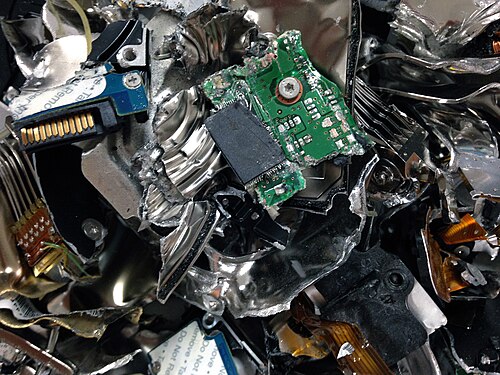
The pieces of a physically destroyed hard disk drive.

Hard drive mechanically broken by a data destroying device (after degaussing)