Renaissance humanism
Videos
Renaissance humanism is a worldview centered on the nature and importance of humanity that emerged from the study of classical antiquity.
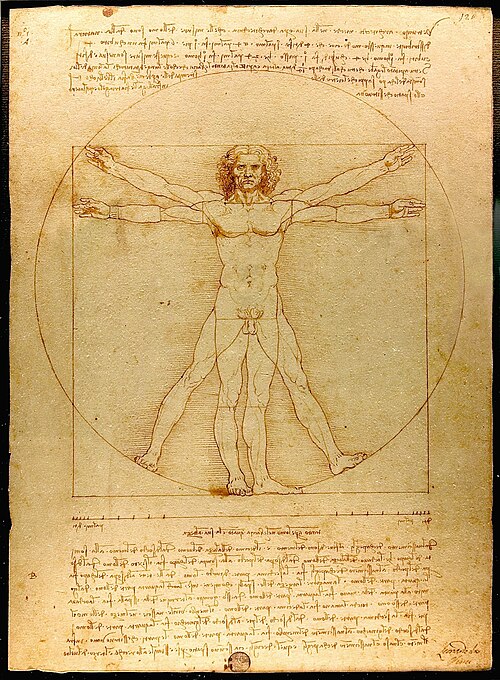
Leonardo da Vinci's Vitruvian Man (c. 1490) shows the correlations of ideal human body proportions with geometry described by the ancient Roman architect Vitruvius in his De Architectura. In his explicit turn back to an ancient model in search of knowledge and wisdom, Leonardo follows early humanist practice. What he finds in Vitruvius is a mathematical formula for the proportions of all parts of the human body, which results in its idealized representation as the true microcosmic measure of all things. [...]The perfection of this ideal human form corresponds visually to the early humanist belief in the unique central placement of human beings within the divine universal order and their consequent human grandeur and dignity, expressed in the philosopher

Medieval and Renaissance Italian writers portrayed by Giorgio Vasari in Six Tuscan Poets (1544). From left to right: Cristoforo Landino, Marsilio Ficino, Francesco Petrarca, Giovanni Boccaccio, Dante Alighieri, and Guido Cavalcanti.
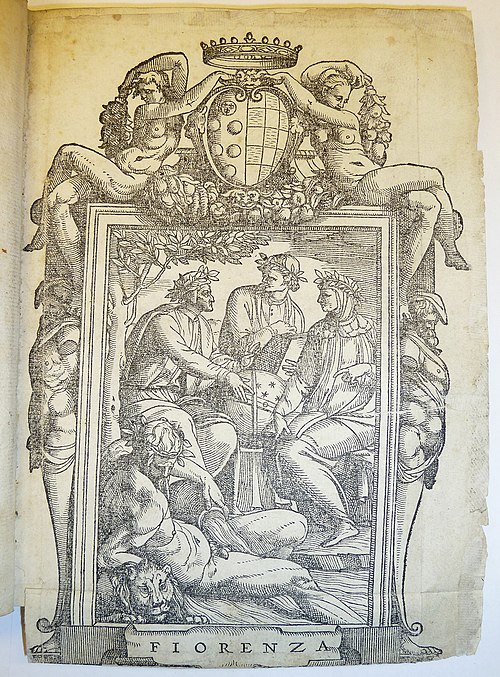
Frontispiece depicting Dante Alighieri, Giovanni Boccaccio, and Francesco Petrarca with the coat of arms of the Medici–Toledo family on top
Humanism
Videos
Humanism is a philosophical stance that emphasizes the agency and the individual and social potential of human beings, whom it considers the starting point for serious moral and philosophical inquiry.
Renaissance humanism
…in the letter. While this discourse was taking place outside the realm of Renaissance Studies (for more on the evolution of the term "humanism," see Humanism), this background debate was not irrelevant to Kristeller and Garin's ongoing disagreement. Kristeller—who had at one point studied under Heidegger—also…

Portrait of Petrarch painted by Altichiero in 1376
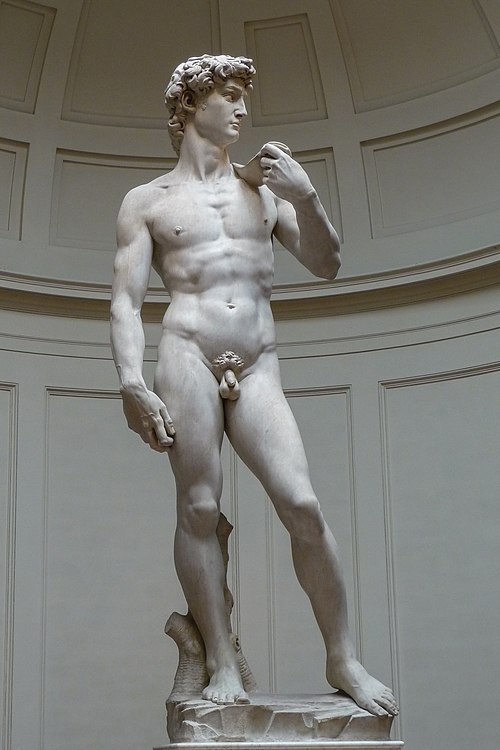
David by Michelangelo, 1501–1504. Artistic work during the Renaissance illustrates the emphasis given to anatomical details of humans.

Henry William Pickersgill, Portrait of Jeremy Bentham, 1829.

Home of Giordano Bruno Foundation in Germany.