Resonator
Videos
A resonator is a device or system that exhibits resonance or resonant behavior. That is, it naturally oscillates with greater amplitude at some frequencies, called resonant frequencies, than at other

RF cavities in the linac of the Australian Synchrotron are used to accelerate and bunch beams of electrons; the linac is the tube passing through the middle of the cavity.

A sport motorcycle, equipped with exhaust resonator, designed for performance
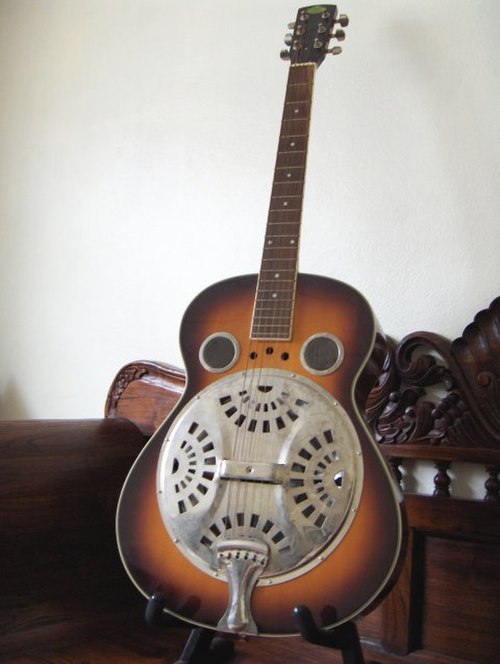
A Dobro-style resonator guitar
Tuning fork
Videos
A tuning fork is an acoustic resonator in the form of a two-pronged fork with the prongs formed from a U-shaped bar of elastic metal. It resonates at a specific constant pitch when set vibrating by st

Tuning fork by John Walker stamped with note (E) and frequency in hertz (659)

Quartz crystal resonator from a modern quartz watch, formed in the shape of a tuning fork. It vibrates at 32,768 Hz, in the ultrasonic range.

A Bulova Accutron watch from the 1960s, which uses a steel tuning fork (visible in center) vibrating at 360 Hz.

1 kHz tuning fork vacuum tube oscillator used by the U.S. National Bureau of Standards (now NIST) in 1927 as a frequency standard.