Ripple Rock
Videos
Ripple Rock is an underwater mountain located in the Seymour Narrows of the Discovery Passage in British Columbia, Canada. It had two peaks that produced large, dangerous eddies from the strong tidal

Aerial view of Ripple Rock in 1957. Note the large, turbulent eddies that formed in its wake during low tide.

The blast breaches the water's surface immediately following detonation.

Debris are ejected as a cloud of dust expands across Seymour Narrows.
Eddy (fluid dynamics)
Videos
In fluid dynamics, an eddy is the swirling of a fluid and the reverse current created when the fluid is in a turbulent flow regime. The moving fluid creates a space devoid of downstream-flowing fluid
Ripple Rock
…Discovery Passage in British Columbia, Canada. It had two peaks (2.74 metres and 6.4 metres below the surface at low tide) that produced large, dangerous eddies from the strong tidal currents that flowed around them at low tide. Ships transiting the strait preferred to wait until slack tide in order to safely…

Reynolds Experiment (1883). Osborne Reynolds standing beside his apparatus.
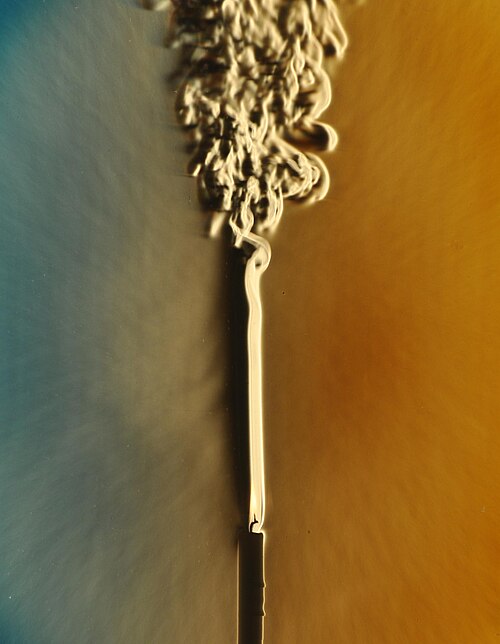
Schlieren photograph showing the thermal convection plume rising from an ordinary candle in still air. The plume is initially laminar, but transition to turbulence occurs in the upper third of the image. The image was made by Gary Settles using a one-meter-diameter schlieren mirror.

Downwind of obstacles, in this case, the Madeira and the Canary Islands off the west African coast, eddies create turbulent patterns called vortex streets.