Roman cursive
Videos
Roman cursive is a form of handwriting used in ancient Rome and to some extent into the Middle Ages. It is customarily divided into old cursive and new cursive, and has different forms. Roman cursive
![Old Roman cursive handwriting from the reign of Claudius (41 to 54 AD), with every i longum transcribed as "j": ...uobis · ujdetur · p[atres] · c[onsc](https://upload.wikimedia.org/wikipedia/commons/thumb/6/6f/I_littera_in_manuscripto.jpg/500px-I_littera_in_manuscripto.jpg)
Old Roman cursive handwriting from the reign of Claudius (41 to 54 AD), with every i longum transcribed as "j": ...uobis · ujdetur · p[atres] · c[onscripti] · decernámus · ut · etiam prólátis · rebus ijs · júdicibus · necessitas · júdicandi jmponátur quj · jntrá rerum · agendárum · dies jncoháta · judicia · non · peregerint · nec defuturas · ignoro · fraudes · monstróse · agentibus multas · aduersus · quas · excogitáuimus · spero...

Beginning of a 4th-century Roman letter, from one Vitalis to a governor named Achillius, showing some litterae grandiores, i.e. letters made larger at the beginning of sentences, ultimately the ancestors of uppercase: domino suo achillio, uitalis. cum in omnibus bonis benignitas tua sit praedita, tum etiam scholasticos et maxime, qui a me cultore tuo hono- rificentiae tuae traduntur, quod honeste respicere velit, non dubito, domine praedicabilis. Quapropter Theofanen...
Uncial script
Videos
Uncial is a majuscule script commonly used from the 4th to 8th centuries AD by Latin and Greek scribes. Uncial letters were used to write Greek and Latin, as well as Gothic, and are the current style
Roman cursive
…likely existed earlier than that. The script uses many ligatures (see, e.g., Tironian notes), and some letters are hard to recognize – "a" looks like an uncial "a", but with the left stroke still straight, "b" and "d" are hard to distinguish, "e" is a full height letter (like the "s"), "p" and "t" are very…

The Book of Kells, c. AD 800, is lettered in a script known as "insular majuscule", a variety of uncial script that originated in Ireland.
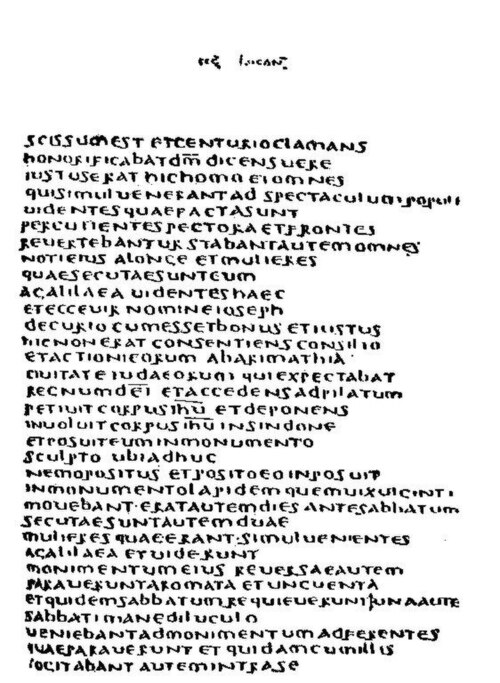
A sample of the Latin text from the Codex Bezae, 5th century AD

A portion of the Codex Sinaiticus, in Byzantine uncial, containing Esther 2:3–8.

An exemplary early 6th-century semi-uncial, Codex Basilicanus S. Petri D 182