Roman festivals
Videos
Festivals in ancient Rome were a very important part of Roman religious life during both the Republican and Imperial eras, and one of the primary features of the Roman calendar. Feriae were either pub

Piece of the fragmentary Fasti Praenestini for April, showing the Vinalia (VIN) and Robigalia (ROB)

A rare depiction of Roman men wearing the toga praetexta and participating in what is probably the Compitalia
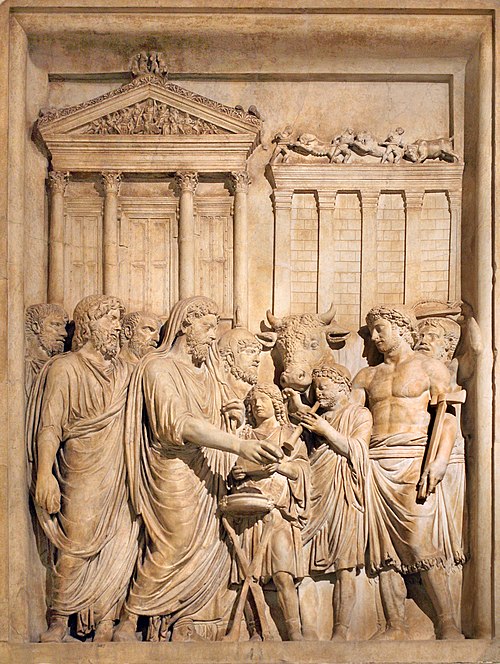
Bas relief from Arch of Marcus Aurelius showing sacrifice
Roman calendar
Videos
The Roman calendar was used by the Roman Kingdom and Roman Republic. Although the term is primarily used for Rome's pre-Julian calendars, it is often used inclusively of the Julian calendar establishe
Roman festivals
…ancient Rome were a very important part of Roman religious life during both the Republican and Imperial eras, and one of the primary features of the Roman calendar. Feriae ("holidays" in the sense of "holy days"; singular also feriae or dies ferialis) were either public (publicae) or private (privatae). State…

A reproduction of the Fasti Antiates Maiores, a painted wall-calendar from the late Roman Republic

The remains of the Fasti Praenestini, containing the months of January, March, April, and December and a portion of February.

July through December sides of the twelve month Menologium Rusticum Colotianum