The Royal manuscripts are one of the "closed collections" of the British Library, consisting of some 2,000 manuscripts collected by the sovereigns of England in the "Old Royal Library" and given to th
Presentation miniature from the Talbot Shrewsbury Book with dedicatory verse under an illuminated miniature of John Talbot, 1st Earl of Shrewsbury (identified by his Talbot dog), presenting the book to Queen Margaret of Anjou seated beside King Henry VI, Royal MS 15 E VI f. 2v


Author portrait of Vincent de Beauvais with borders decorated with the arms of Edward IV in Bruges, c. 1478-1480, Royal MS 14 E I vol 1 f3r

Detail of miniature from the Westminster Psalter, c. 1250, Royal MS 2 A XXII, f. 220

The death of Walter VI, Count of Brienne in 1356 at the Battle of Poitiers, from one of Edward IV's histories, Royal MS 14 E v f.499v
Codex Alexandrinus
Videos
The Codex Alexandrinus is a manuscript of the Greek Bible, written on parchment. It is designated by the siglum A or 02 in the Gregory-Aland numbering of New Testament manuscripts, and δ 4 in the von
Royal manuscripts, British Library
…Wolsey and Thomas Cromwell. Many older manuscripts were presented to monarchs as gifts; perhaps the most important manuscript in the collection, the Codex Alexandrinus, was presented to Charles I in recognition of the diplomatic efforts of his father James I to help the Eastern Orthodox churches under the rule of the…
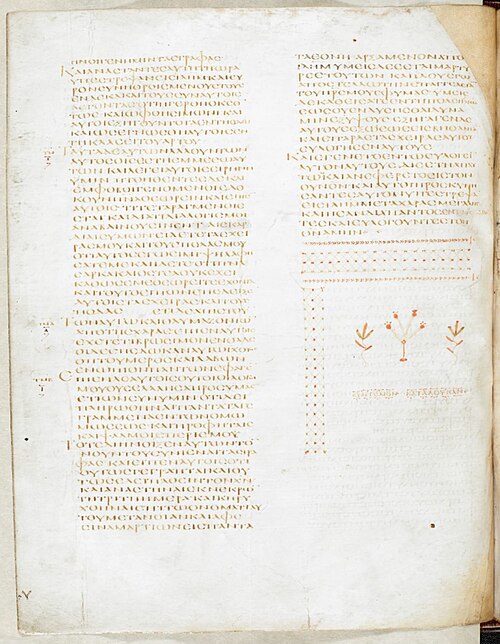
Folio 41v from the Codex Alexandrinus contains the end of the Gospel of Luke with the decorative tailpiece found at the end of each book

List of chapters (κεφάλαια) in the Gospel of Mark

A vacant space proportionate to the break in the sense follows the end of a paragraph (page with text of Mark 6:27–54)

Colophon at the end of the Epistle of Jude. According to this colophon Acts of the Apostles follows General epistles