Rusher's Patent Types were the characters of an experimental serif typeface invented, patented and promoted by Philip Rusher in Banbury, England, from 1802 onwards. The typeface removed the descenders from the lower-case letters and shortened the ascenders, which Rusher hoped would make the typeface "more uniform" and save paper. The typeface was used for a few books but did not become popular.
An 1856 lithograph and 1802 engraving reproducing the drawing in Rusher's patent filing.
Page 61 of Philip Rusher's edition of Rasselas. This section uses a small cap 'g' at the start of words.
Philip Rusher's nephew John Golby Rusher became a successful publisher in Banbury for many years, often printing nursery rhymes such as Old Mother Hubbard and Jack and Jill. This 1840 book does not use Rusher's types.
Image: Rusher 1856 lithograph
The Caslon type foundry was a type foundry in London which cast and sold metal type. It was founded by the punchcutter and typefounder William Caslon I, probably in 1720. For most of its history it was based at Chiswell Street, Islington, was the oldest type foundry in London, and the most prestigious.
Painting of William Caslon, founder of the Caslon type foundry, by Francis Kyte. He holds his specimen of his types.
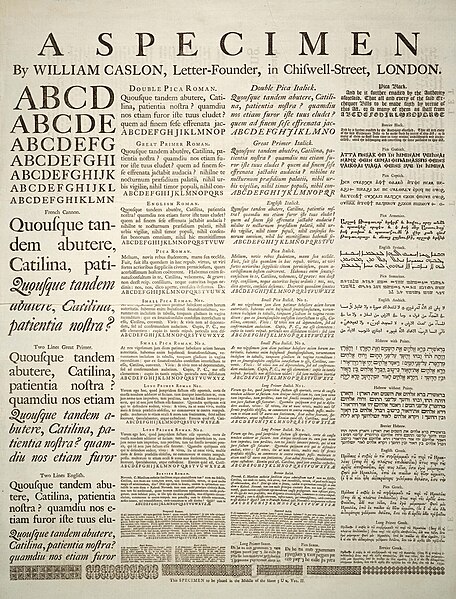
William Caslon's specimen sheet (dated 1734 but actually issued from 1738 onwards). Some of the types shown were not cut by Caslon, most notably the French Canon roman (probably cut by Joseph Moxon)
The Caslon family chest tomb at St Luke's, Old Street
During the late 18th century the poster began to appear, creating a new market for printing. A watercolour of a theatre shows posters outside