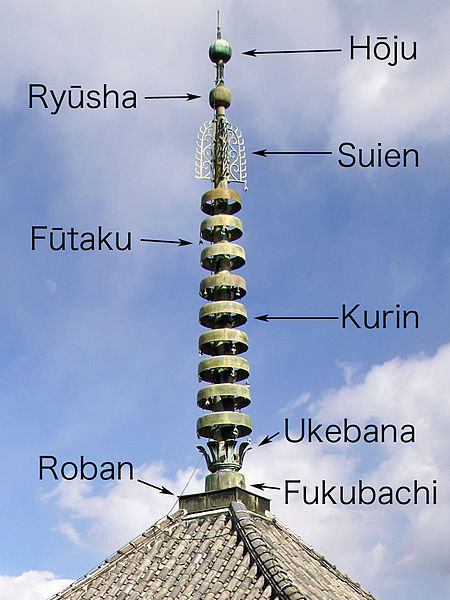
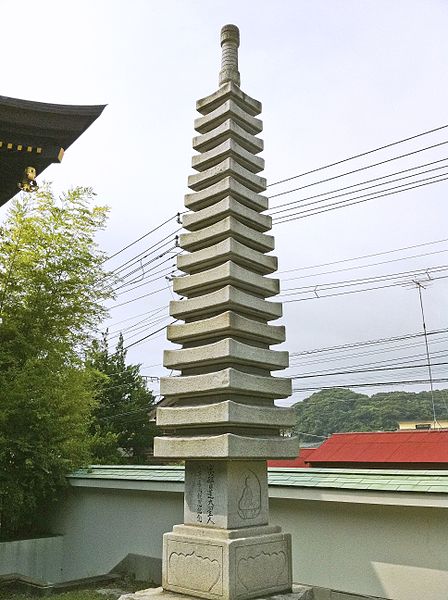
The sōrin is the vertical shaft (finial) which tops a Japanese pagoda, whether made of stone or wood. The sōrin of a wooden pagoda is usually made of bronze and can be over 10 meters tall. That of a stone pagoda is also of stone and less than a meter long. The sōrin is divided in several sections possessing a symbolic meaning and, as a whole, in turn itself represents a pagoda.
Replica of the suien of Yakushi-ji's Eastern Pagoda
Hōkyōintō with sōrin
Image: Tenneiji Onomichi 03s 3200 Sourin
Image: Houkyouintou sourin
Pagodas in Japan are called tō , sometimes buttō or tōba , and derive historically from the Chinese pagoda, itself an interpretation of the Indian stupa. Like the stupa, pagodas were originally used as reliquaries, but in many cases ended up losing this function. Pagodas are quintessentially Buddhist and an important component of Japanese Buddhist temple compounds but, because until the Kami and Buddhas Separation Act of 1868, a Shinto shrine was normally also a Buddhist temple and vice versa, they are not rare at shrines either. The famous Itsukushima Shrine, for example, has one. After the Meiji Restoration the word tō, once used exclusively in a religious context, came to mean also "tower" in the western sense, as for example in Eiffel Tower .
Japan's oldest three-storeyed pagoda at Hokki-ji, Ikaruga, Nara Pref. It was built in 706.
A reconstruction of Asuka-dera's original layout with a pagoda at its center
A rare 16-storey stone pagoda at Chōshō-ji in Kamakura
A hōtō at Ankokuron-ji