Salyut programme
Videos
The Salyut programme was the first space station programme, undertaken by the Soviet Union. It involved a series of four crewed scientific research space stations and two crewed military reconnaissanc

Development of the Soviet space stations: The large horizontal arrows trace the evolution of the two Soviet space station programmes DOS (top) and Almaz-OPS (bottom) Dark gray arrows trace the infusions from the Soyuz and OPS programmes to DOS Solid and dashed black arrows indicate modules intended for Mir, containing influences from OPS with the addition of space tugs

Mockup of Soyuz and Progress spacecraft docked to Salyut 6, Moscow Polytechnical Museum

DOS-5 (Salyut 6) space station with two docked spacecraft

A full-scale model of a Salyut 7 space station and two docked spacecraft. On the left a Soyuz can be seen docked to the fore port, and on the right a Progress is docked at the aft port. The display is in front of one of the pavilions of the Exhibition of Soviet National Economic Achievement.
Mir
Videos
Mir was a space station operated in low Earth orbit from 1986 to 2001, first by the Soviet Union and later by the Russian Federation. Mir was the first modular space station and was assembled in orbit
Salyut programme
…whose technological legacy continues as of 2023. Experience gained from the Salyut stations paved the way for multimodular space stations such as Mir and the International Space Station (ISS), with each of those stations possessing a Salyut-derived core module at its heart. Mir-2 (DOS-8), the final…
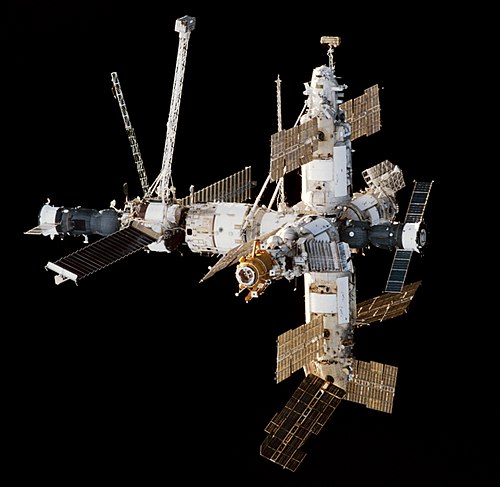
Mir seen from Space Shuttle Endeavour during STS-89 (28 January 1998)

The Travers radar antenna, Sofora girder, VDU thruster block, SPK unit and a Strela crane, alongside Kvant-2 and Priroda

The four solar arrays on Spektr

Reinhold Ewald (right) and Vasily Tsibliyev in the core module during Ewald's visit to Mir