Samye, full name Samye Mighur Lhundrub Tsula Khang and Shrine of Unchanging Spontaneous Presence is the first Tibetan Buddhist and Nyingma monastery built in Tibet, during the reign of King Trisong Deutsen. Shantarakshita began construction around 763, and Tibetan Vajrayana founder Guru Padmasambhava tamed the local spirits for its completion in 779. The first Tibetan monks were ordained there. Samye was destroyed during the Cultural Revolution then rebuilt after 1988.
The main building of the Samye Monastery (3D model available in Google Earth)
General view of Samye, photographed in 1936 by Hugh Edward Richardson.
Detail of the pillar inscription at Samye, photographed in 1949 by Hugh Edward Richardson. University of Oxford. Available at: http://tibet.prm.ox.ac.uk/photo_2001.59.13.38.1.html
The protective wall of Samye
Tibetan Buddhism is a form of Buddhism practiced in Tibet, Bhutan and Mongolia. It also has a sizable number of adherents in the areas surrounding the Himalayas, including the Indian regions of Ladakh, Sikkim, and Arunachal Pradesh, as well as in Nepal. Smaller groups of practitioners can be found in Central Asia, Xinjiang, Inner Mongolia, and some regions of Russia, such as Tuva, Buryatia, and Kalmykia.
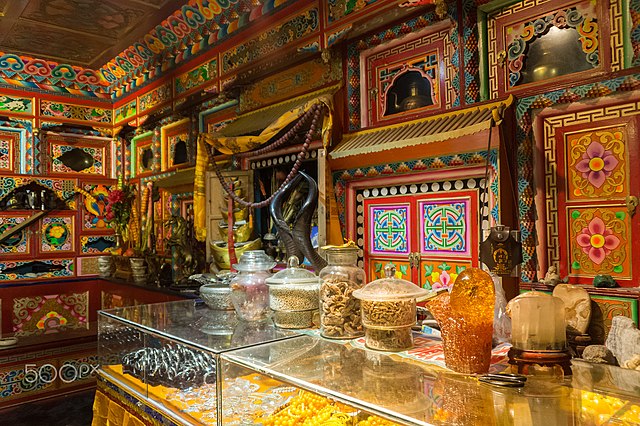
Inside of a Tibetan Buddhist monastery
Samye was the first gompa (Buddhist monastery) built in Tibet (775–779).
The Indian master Atiśa
The Tibetan householder and translator Marpa (1012–1097)