Sea ice
Videos
Sea ice forms as seawater freezes. Because ice is less dense than liquid water, it floats on the ocean's surface. Sea ice covers about 7% of the Earth's surface and about 12% of the world's oceans. Mu

Broken pieces of Arctic sea ice with a snow cover

Nilas in Baffin Bay

Aerial view showing an expanse of drift ice offshore Labrador (Eastern Canada) displaying floes of various sizes loosely packed, with open water in several networks of leads. (Scale not available.)

Aerial view showing an expanse of drift ice consisting mostly of water. (Scale not available.)
Glacier
Videos
A glacier is a persistent body of natural ice, a form of rock, that is constantly moving under its own weight. A glacier forms where the accumulation of snow exceeds its ablation over many years, ofte
Sea ice
…and temperature fluctuations, which lead to a wide variety of ice types and features. Sea ice differs from icebergs, which are chunks of ice shelves or glaciers that calve into the ocean. Depending on location, sea ice may contain embedded icebergs. Sea ice does not simply grow and melt. During its lifespan…

Glacier of the Geikie Plateau in Greenland

The Taschachferner in the Ötztal Alps in Austria. The mountain to the left is the Wildspitze (3,768 m), the second highest in Austria

The Baltoro Glacier in Pakistan. It is 62 kilometres (39 mi) long, the fifth longest alpine glacier in the world.
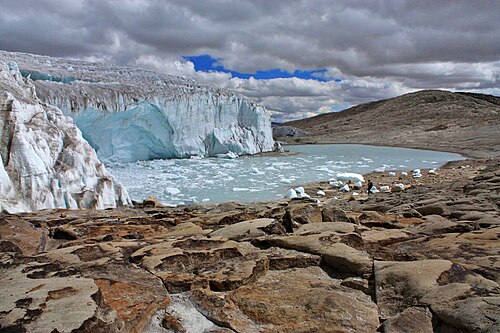
The Quelccaya Ice Cap in Peru is the second-largest glaciated area in the tropics