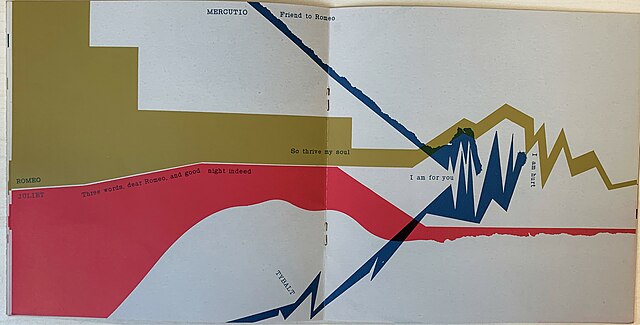
Shigeo Fukuda was a sculptor, medallist, graphic artist and poster designer who created optical illusions. He is one of Japan's most well-known post-war graphic designers. He is known to be an environmentalist and anti-war, for he designed posters on these social issues. His art pieces usually portray deception, such as Lunch With a Helmet On, a sculpture created entirely from forks, knives, and spoons, that casts a detailed shadow of a motorcycle.
Illustration to Romeo and Juliet, 1965
In visual perception, an optical illusion is an illusion caused by the visual system and characterized by a visual percept that arguably appears to differ from reality. Illusions come in a wide variety; their categorization is difficult because the underlying cause is often not clear but a classification proposed by Richard Gregory is useful as an orientation. According to that, there are three main classes: physical, physiological, and cognitive illusions, and in each class there are four kinds: Ambiguities, distortions, paradoxes, and fictions. A classical example for a physical distortion would be the apparent bending of a stick half immerged in water; an example for a physiological paradox is the motion aftereffect. An example for a physiological fiction is an afterimage. Three typical cognitive distortions are the Ponzo, Poggendorff, and Müller-Lyer illusion. Physical illusions are caused by the physical environment, e.g. by the optical properties of water. Physiological illusions arise in the eye or the visual pathway, e.g. from the effects of excessive stimulation of a specific receptor type. Cognitive visual illusions are the result of unconscious inferences and are perhaps those most widely known.
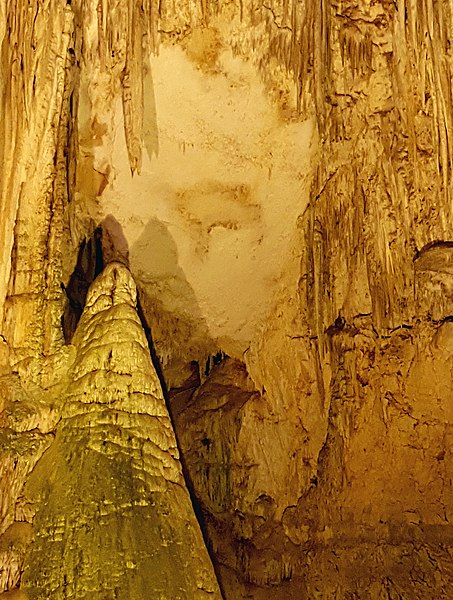
"The Organ Player" – Pareidolia phenomenon in Neptune's Grotto stalactite cave (Alghero, Sardinia)
Rabbit–duck illusion
"Shepard tables" deconstructed. The two tabletops appear to be different, but they are the same size and shape.
A visual representation of what an amputee with phantom limb syndrome senses