Siberian intervention
Videos
The Siberian intervention or Siberian expedition of 1918–1922 was the dispatch of troops of the Entente powers to the Russian Maritime Provinces as part of a larger effort by the western powers, Japan, and China to support White Russian forces and the Czechoslovak Legion against Soviet Russia and its allies during the Russian Civil War. The Imperial Japanese Army continued to occupy Siberia even after other Allied forces withdrew in 1920.

Allied commanders of the Siberian intervention. Front row: William S. Graves (3rd), Otani Kikuzo (4th) and Yui Mitsue (5th).
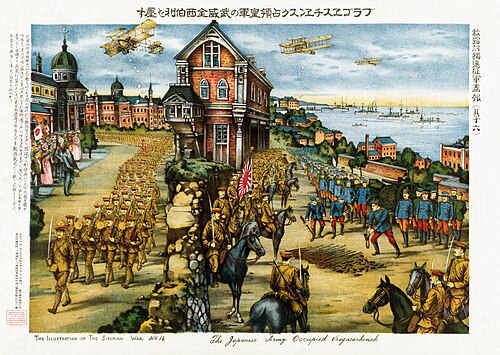
Japanese lithograph depicting the capture of Blagoveshchensk
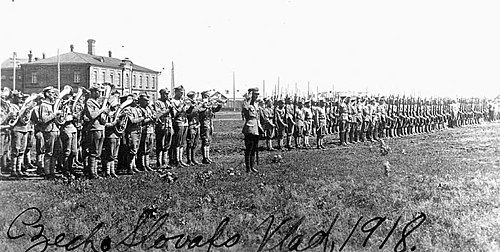
Czechoslovak Legion soldiers in Vladivostok, 1918

Foreign Minister N. D. Merkulov, Admiral G. K. Stark, Chairman S. D. Merkulov of the Provisional Priamurye Government, surviving behind a cordon sanitaire of Japanese troops involved in the Siberian Intervention.
Russian Civil War
Videos
The Russian Civil War was a multi-party civil war in the former Russian Empire sparked by the overthrowing of the social-democratic Russian Provisional Government in the October Revolution, as many factions vied to determine Russia's political future. It resulted in the formation of the Russian Socialist Federative Soviet Republic and later the Soviet Union in most of its territory. Its finale marked the end of the Russian Revolution, which was one of the key events of the 20th century.

Admiral Alexander Kolchak (seated) and General Alfred Knox (behind Kolchak) observing military exercise, 1919

Viktor Chernov

Vladimir Pchelin's depiction of the assassination attempt on Lenin

Anti-Bolshevik Volunteer Army in South Russia, January 1918