Siege of Alexandria (641)
Videos
Forces of the Rashidun Caliphate seized the major Mediterranean port of Alexandria from the Eastern Roman Empire in the middle of the 7th century AD. Alexandria had been the capital of the Byzantine p

Western tower, remains of the Hellenistic city wall fortifications.

Ancient Roman theater in Alexandria (present-day archeological site of Kom El Deka)

The Attarine Mosque in Alexandria was originally a church but was converted to a mosque after the surrender of Alexandria.
Amr ibn al-As
Videos
Amr ibn al-As ibn Wa'il al-Sahmi was an Arab commander and companion of Muhammad who led the Muslim conquest of Egypt and served as its governor in 640–646 and 658–664. The son of a wealthy Qurayshite
Siege of Alexandria (641)
…his sights on the economically desirable province of Egypt and its capital city of Alexandria. The Muslim invasion of Egypt was led by the commander Amr ibn Al-Aas, who commanded a force larger than any army that the Byzantines could field at the time, as a result of their crushing defeat at Yarmuk four years…

The Amr ibn al-As Mosque in Fustat (Old Cairo), Egypt

The ravines of the Yarmouk River where Amr kept the Byzantines confined at the decisive Battle of Yarmouk in 636

Amr initially halted his campaign at the Babylon Fortress (pictured in 2008), but ultimately forced its Byzantine garrison to evacuate in April 641 after a lengthy siege.
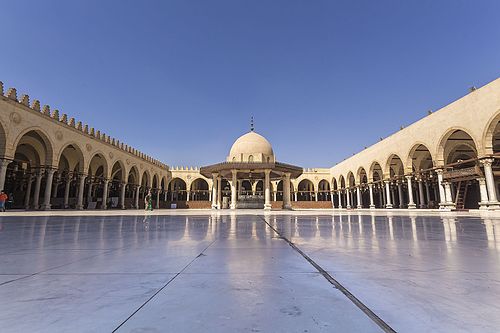
The courtyard of the Amr ibn al-As Mosque in 2013. The mosque was originally founded by Amr in 641 but was redesigned and expanded significantly over the next several centuries.