Six Dynasties poetry
Videos
Six Dynasties poetry refers to the types or styles of poetry particularly associated with the Six Dynasties era of Chinese history. This poetry reflects one of the poetry world's more important flower
Master Jingjie (the posthumous name for Tao Yuanming). Text at top is from the Fu style poem 歸去來兮. By Wang Zhongyu, Ming dynasty (1368–1644).


Cao Cao cites a poem before the Battle of Red Cliffs. Portrait at the Long Corridor of the Summer Palace, Beijing.
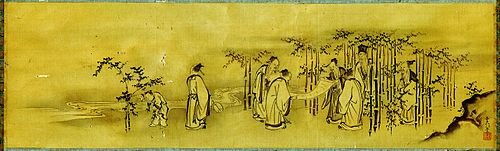
The Seven Sages of the Bamboo Grove (with boy attendant), in a Kano school Japanese painting of the Edo period

Possible representation of Ruan Ji. Attributed to Sun Wei, second half of 9th century.
Three Kingdoms
Videos
The Three Kingdoms of Cao Wei, Shu Han, and Eastern Wu dominated China from 220 to 280 AD following the end of the Han dynasty. This period was preceded by the Eastern Han dynasty and was followed by
Six Dynasties poetry
…traditional selection criteria are chosen. The Six Dynasties era covers several somewhat overlapping main periods including all of the following: the Three Kingdoms (220–280), Jin dynasty (266–420, in two approximate parts, Western Jin 266–316 and Eastern Jin 317–420), the Sixteen Kingdoms (also known as the "Sixteen…

Bronze turtle holding a cup, Eastern Wu

Cao Zhi as depicted in Goddess of Luo River (detail) by Gu Kaizhi
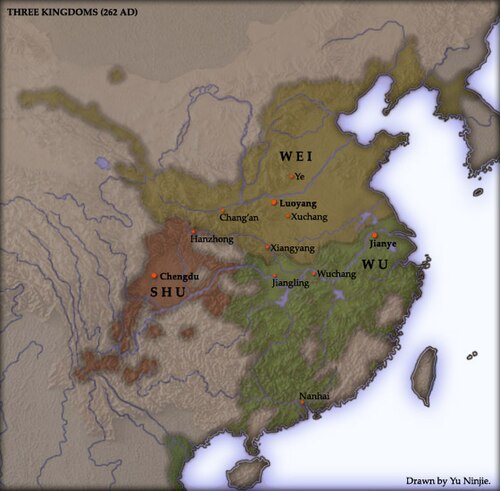
Three Kingdoms in 262, on the eve of the conquest of Shu, Wei and Wu

Pottery dwelling around a large courtyard, a siheyuan. Unearthed in 1967 in a tomb of Hubei built during the kingdom of Eastern Wu, National Museum of China, Beijing