Spanish Constitution of 1812
Videos
The Political Constitution of the Spanish Monarchy, also known as the Constitution of Cádiz and as La Pepa, was the first Constitution of Spain and one of the earliest codified constitutions in world history. The Constitution was ratified on 19 March 1812 by the Cortes of Cádiz, the first Spanish legislature that included delegates from the entire nation and its possessions, including Spanish America and the Philippines. "It defined Spanish and Spanish American liberalism for the early 19th century."
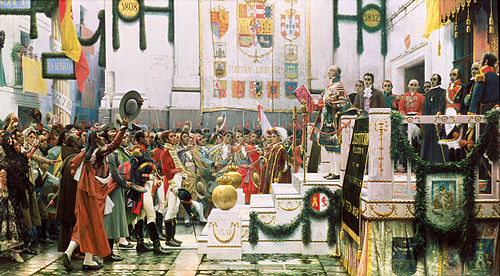
The promulgation of the Constitution of 1812, the work of Salvador Viniegra (Museo de las Cortes de Cádiz).

Cortes of Cádiz Oath in 1810. Oil painting by José Casado del Alisal, 1863.

Lithograph of Mexico City's Zócalo, c. 1800. The square is officially known as the Plaza de la Constitución. Named during the tail-end of the colonial era for the Cadiz Constitution, not the later Constitution of Mexico.

Repeal of the Constitution of 1812 by Fernando VII in the palace of Cervellón, Valencia, Spain.
Siege of Cádiz
Videos
The siege of Cádiz was a siege of the large Spanish naval base of Cádiz by a French army from 5 February 1810 to 24 August 1812 during the Peninsular War. Following the occupation of Seville, Cádiz became the Spanish seat of power, and was targeted by 70,000 French troops under the command of the Marshals Claude Victor and Nicolas Jean-de-Dieu Soult for one of the most important sieges of the war. Defending the city were 2,000 Spanish troops who, as the siege progressed, received aid from 10,000 Spanish reinforcements as well as British and Portuguese troops.


Portrait of General Manuel la Peña, commander of the Coalition forces that attempted to relieve the siege

Portrait of Thomas Graham.

Plan of Cádiz in 1812