Storegga Slide
Videos
The three Storegga Slides are amongst the largest known submarine landslides. They occurred at the edge of Norway's continental shelf in the Norwegian Sea, approximately 6225–6170 BCE. The collapse in

The yellow numbers give the height of the tsunami wave as indicated by tsunamites studied by researchers.

Storegga tsunami deposits (grey upper layer), bracketed by peat (dark brown layers), taken at Maryton on the Montrose Basin, Scotland
Doggerland
Videos
Doggerland was a large area of land in Northern Europe, now submerged beneath the southern North Sea. This region was repeatedly exposed at various times during the Pleistocene epoch due to the loweri
Storegga Slide
…accumulated sediment along with it. At, or shortly before, the time of the Second Storegga Slide, a land bridge known to archaeologists and geologists as Doggerland linked Britain, Denmark and the Netherlands across what is now the southern North Sea. This area is believed to have included a coastline of lagoons…

Situation of the southern North Sea during Marine Isotope Stages (MIS) 25-21 (c. 1 million-800,000 years ago) MIS 17 (c. 700,000 years ago), MIS 12 (Anglian) glaciation (c. 480-425,000 years ago) and MIS 11 (Hoxnian) interglacial (c. 425-375,000 years ago)

Paleogeography of the southern North Sea during Marine Isotope Stages (MIS) 19-13 (c. 800,000-480,000 years ago) during episodes of high (left) and low (right) sea level
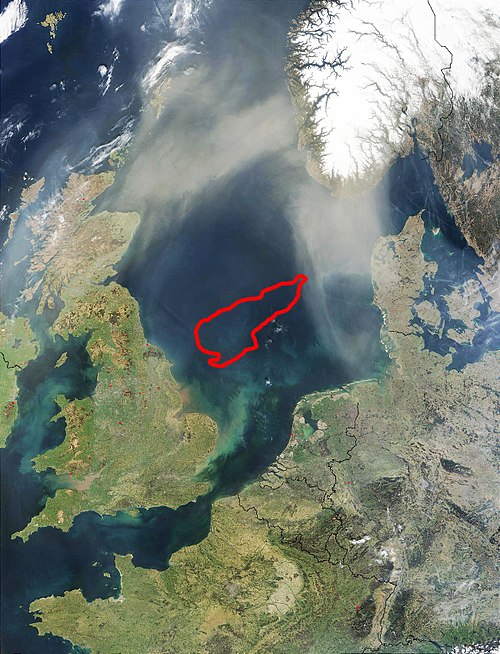
The red line marks Dogger Bank, which is most likely a moraine formed in the Pleistocene

A Woolly mammoth skull discovered by fishermen in the North Sea, at the Celtic and Prehistoric Museum, Ireland