Suebian knot
Videos
The Suebian knot is a historical male hairstyle ascribed to the tribe of the Germanic Suebi. The knot is attested by Tacitus in his 1st century AD work Germania, found on contemporary depictions of Ge
The Osterby Head with Suebian knot


Hair of Dätgen Man, 135–385 AD, found in Germany

Marble head (1st/2nd century AD) found in Somzée, Wallonia, Belgium

German at Wien Museum (2nd century AD)
Germanic peoples
Videos
The Germanic peoples were tribal groups who lived in Northern Europe during Classical antiquity and the Early Middle Ages. In modern scholarship, they typically include the Roman-era Germani who lived
Suebian knot
…The Suebian knot (German: Suebenknoten) is a historical male hairstyle ascribed to the tribe of the Germanic Suebi. The knot is attested by Tacitus in his 1st century AD work Germania, found on contemporary depictions of Germanic peoples, their art, and bog…

Roman bronze statuette dated to the late 1st century – early 2nd century CE, representing a Germanic man with his hair in a Suebian knot

The inscription on the Negau helmet B, carved in the Etruscan alphabet during the 3rd–2nd c. BCE, is generally regarded as Proto-Germanic.
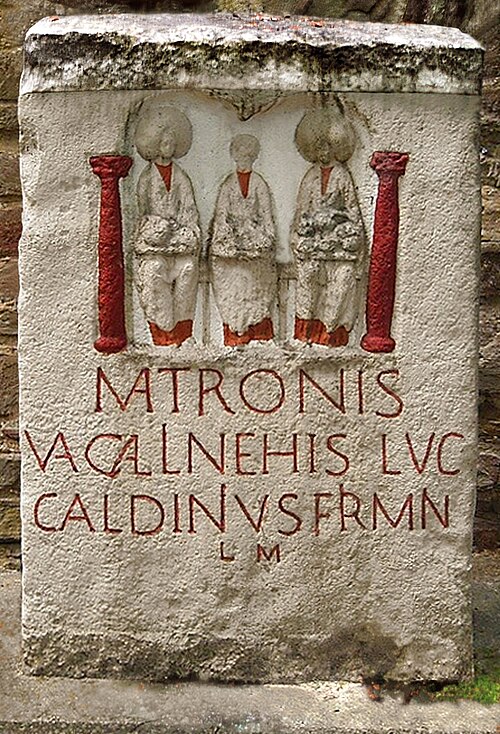
Replica of an altar for the Matrons of Vacallina (Matronae Vacallinehae) from Mechernich-Weyer, Germany
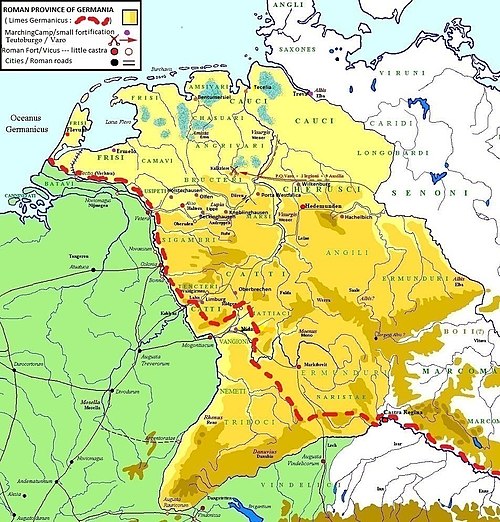
The Roman province of Germania, in existence from 7 BCE to 9 CE. The dotted line represents the Limes Germanicus, the fortified border constructed following the final withdrawal of Roman forces from Germania.