Sugawara no Michizane
Videos
Sugawara no Michizane, or Kankō, was a scholar, poet, and politician of the Heian period of Japan. He is regarded as an excellent poet, particularly in waka and kanshi poetry, and is today revered in
Kanke, from the Ogura Hyakunin Isshu.


Sugawara Michizane in Exile by Kobayashi Kiyochika, 1884

Tenjin (Michizane) Crossing to China, late 15th century by Sesshin, Muromachi period, Ink on paper

Ukiyo-e by Tsukioka Yoshitoshi depicting Sugawara no Michizane as the Tenjin (kami of thunder.). After Sugawara no Michizane's death, lightning struck the palace, killing and injuring many of the powerful people involved in his banishment, and Sugawara no Michizane was enshrined in the Tenmangū (Shinto shrines) as the Tenjin.
Taira no Masakado
Videos
Taira no Masakado was a Heian period provincial magnate and samurai based in eastern Japan, notable for leading the first recorded uprising against the central government in Kyōto. Along with Sugawara
Sugawara no Michizane
…to Tenjin). In the famed poem anthology Hyakunin Isshu, he is known as Kanke (菅家), and in kabuki drama he is known as Kan Shōjō (菅丞相). Along with Taira no Masakado and Emperor Sutoku, he is often called one of the "Three Great Onryō of Japan". He was born into a family of scholars, who bore the hereditary title…

Portrait of Masakado formerly kept at Tsukudo Shrine (築土神社) in Chiyoda, Tokyo. The original painting was destroyed in 1945.

Kanmu, 50th emperor of Japan. The branch of the Taira clan (Heishi) to which Masakado belonged, the Kanmu Heishi (桓武平氏), traces itself from Kanmu's children who were not considered eligible for the throne.
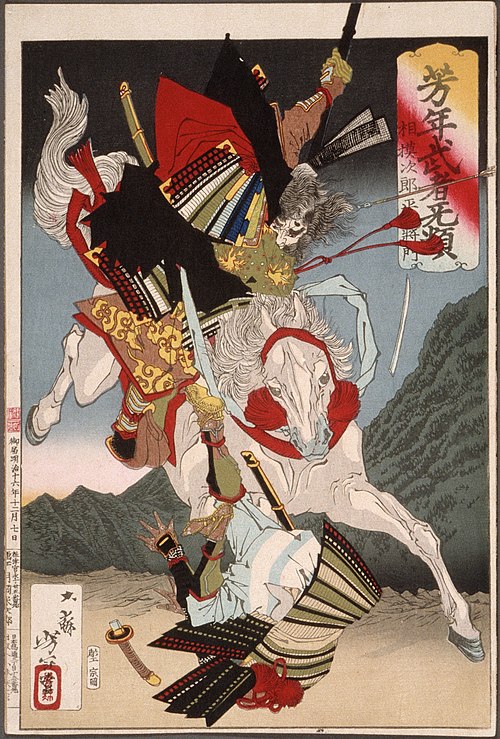
Masakado attacking an opponent on horseback (Yoshitoshi)

Takiyasha-hime, the sorceress, is shown carrying a sword in one hand, a bell in the other, and a torch in her mouth; the toad, her familiar, is shown in the inset with her father, Taira no Masakado. Ukiyo-e woodblock print by Yōshū Chikanobu, 1884.