Taira no Masakado
Videos
Taira no Masakado was a Heian period provincial magnate and samurai based in eastern Japan, notable for leading the first recorded uprising against the central government in Kyōto. Along with Sugawara

Portrait of Masakado formerly kept at Tsukudo Shrine (築土神社) in Chiyoda, Tokyo. The original painting was destroyed in 1945.

Kanmu, 50th emperor of Japan. The branch of the Taira clan (Heishi) to which Masakado belonged, the Kanmu Heishi (桓武平氏), traces itself from Kanmu's children who were not considered eligible for the throne.
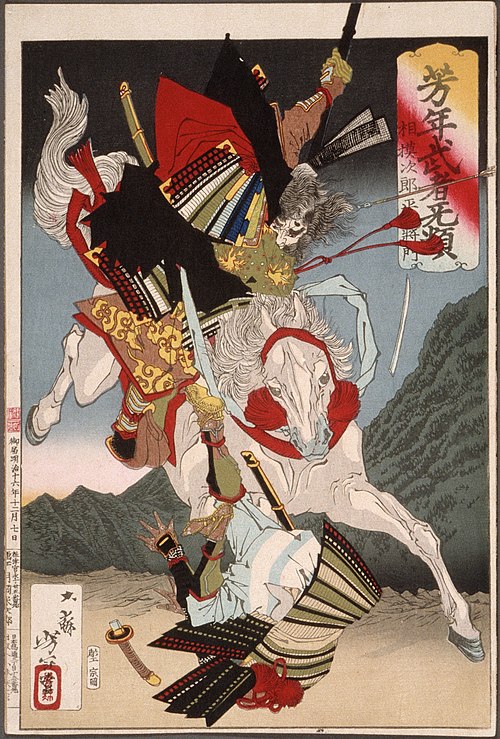
Masakado attacking an opponent on horseback (Yoshitoshi)

Takiyasha-hime, the sorceress, is shown carrying a sword in one hand, a bell in the other, and a torch in her mouth; the toad, her familiar, is shown in the inset with her father, Taira no Masakado. Ukiyo-e woodblock print by Yōshū Chikanobu, 1884.
Taira clan
Videos
The Taira was one of the four most important clans that dominated Japanese politics during the Heian period of Japanese history, the others being the Minamoto, the Fujiwara, and the Tachibana. The cla
Taira no Masakado
…of the "Three Great Onryō of Japan". Masakado was one of the sons of Taira no Yoshimasa (平良将), also known as Taira no Yoshimochi (平良持), of the Kanmu Taira clan (Kanmu Heishi), descendants of Emperor Kanmu (reigned 781–806) who were demoted from princely to commoner status and granted the Taira surname. Yoshimochi…

Yoshitsune and Benkei defending themselves in their boat during a storm created by the ghosts of conquered Taira warriors (by Utagawa Kuniyoshi)