Sunni Islam
Videos
Sunni Islam is the largest branch of Islam and the largest religious denomination in the world. It holds that Muhammad did not appoint any successor and that his closest companion Abu Bakr rightfully

Istiqlal Mosque in Jakarta, Indonesia. Indonesia has the largest population of Muslims in the world, the majority of whom are Sunni.

The Great Mosque of Kairouan (also known as the Mosque of Uqba) in the city of Kairouan, Tunisia, was, particularly from the 9th to 11th century, an important center of Islamic learning with an emphasis on the Maliki Madh'hab.

Muhammed accompanied by the archangels Gabriel, Michael, Israfil and Azrael. Turkish Siyer-i-Nebi-work, 1595

Historic Quran of Old Dhaka, Bangladesh
Islam
Videos
Islam is an Abrahamic religion based on the Quran and the teachings of Muhammad. The monotheistic religion has an estimated 2 billion worldwide adherents, called Muslims. Islam is the world's second-l
Sunni Islam
…Sunni Islam is the largest branch of Islam and the largest religious denomination in the world. It holds that Muhammad did not appoint any successor and that his closest companion Abu Bakr (r…

The Kaaba at Masjid al-Haram in Mecca, Saudi Arabia, the holiest Islamic site
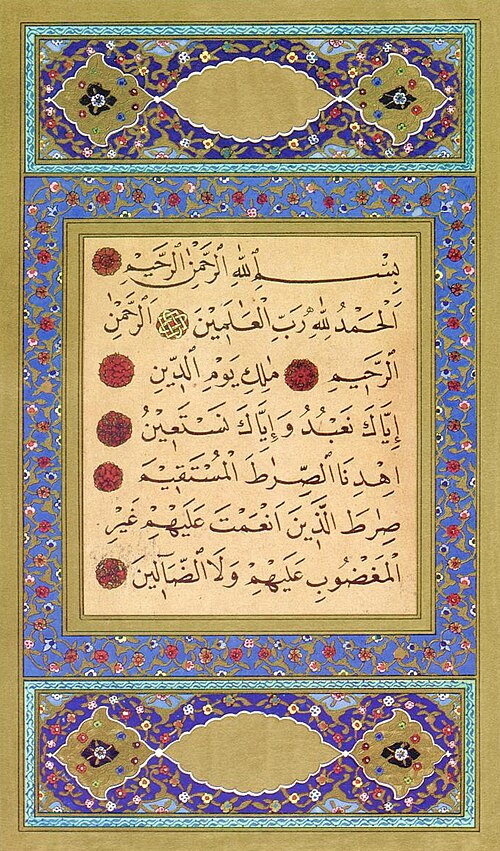
al Fatiha (The Opener), a surah from the Quran

Calligraphy showing the word Allah in Arabic in Hagia Sophia

A Quran manuscript resting on a rehal, a book rest for the holy text, c. 9th century