A superheterodyne receiver, often shortened to superhet, is a type of radio receiver that uses frequency mixing to convert a received signal to a fixed intermediate frequency (IF) which can be more conveniently processed than the original carrier frequency. It was invented by French radio engineer and radio manufacturer Lucien Lévy. Virtually all modern radio receivers use the superheterodyne principle.
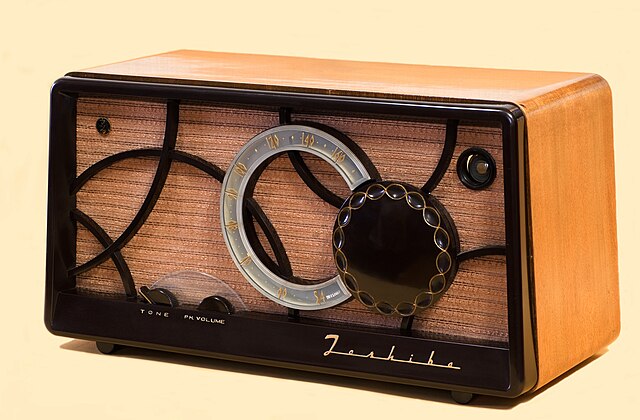
A 5-tube superheterodyne receiver manufactured by Toshiba circa 1955
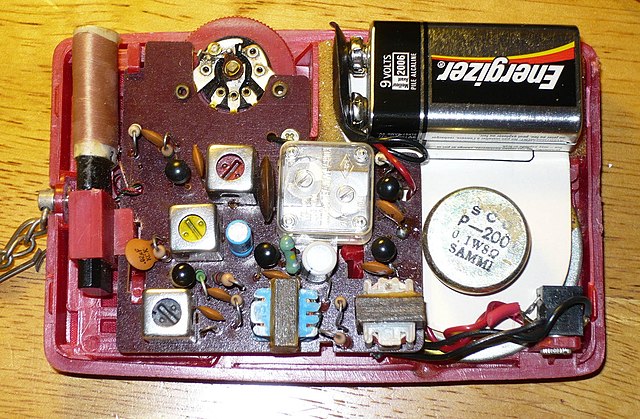
Superheterodyne transistor radio circuit circa 1975
One of the prototype superheterodyne receivers built at Armstrong's Signal Corps laboratory in Paris during World War I. It is constructed in two sections, the mixer and local oscillator (left) and three IF amplification stages and a detector stage (right). The intermediate frequency was 75 kHz.
The first commercial superheterodyne receiver, the RCA Radiola AR-812, released on March 4, 1924, priced at $286 (equivalent to $5,080 in 2023). It used 6 triodes: a mixer, local oscillator, two IF and two audio amplifier stages, with an IF of 45 kHz. It was a commercial success, with better performance than competing receivers.
In radio communications, a radio receiver, also known as a receiver, a wireless, or simply a radio, is an electronic device that receives radio waves and converts the information carried by them to a usable form. It is used with an antenna. The antenna intercepts radio waves and converts them to tiny alternating currents which are applied to the receiver, and the receiver extracts the desired information. The receiver uses electronic filters to separate the desired radio frequency signal from all the other signals picked up by the antenna, an electronic amplifier to increase the power of the signal for further processing, and finally recovers the desired information through demodulation.
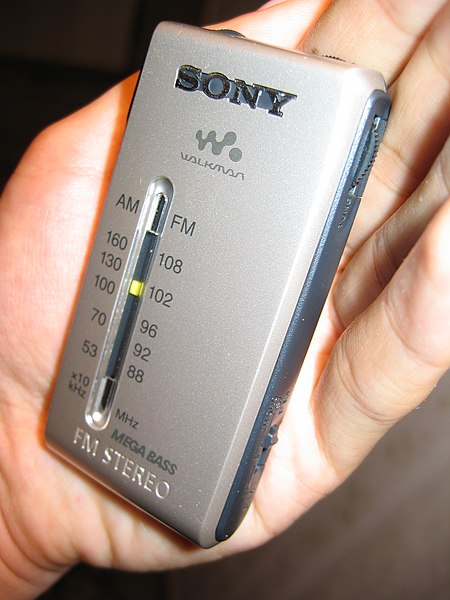
A portable battery-powered AM/FM broadcast receiver, used to listen to audio broadcast by local radio stations.
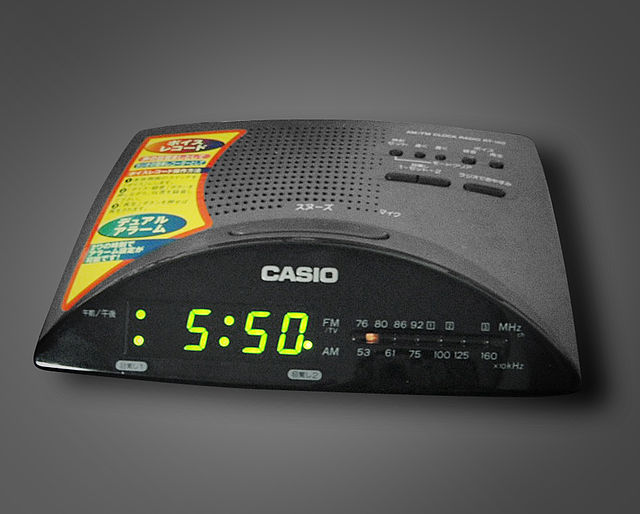
A bedside clock radio that combines a radio receiver with an alarm clock
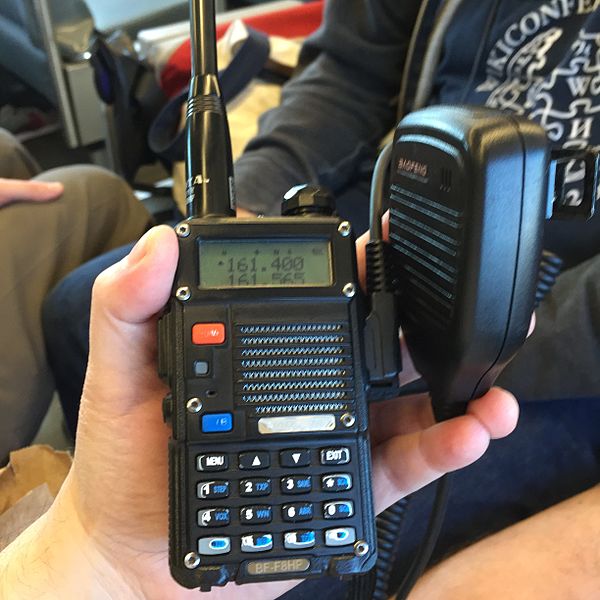
Handheld scanner
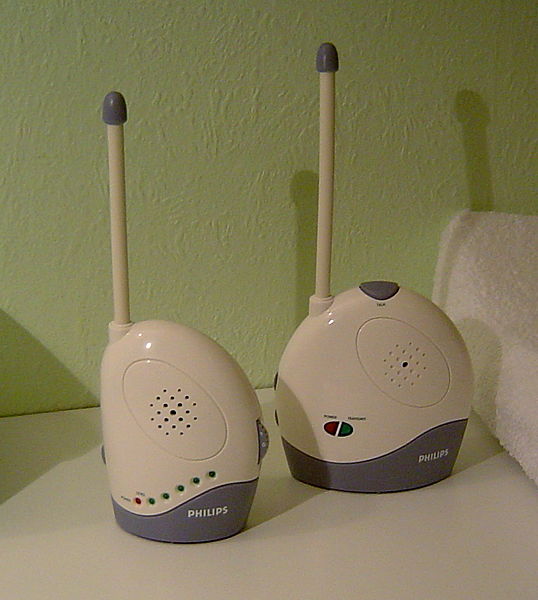
Baby monitor. The receiver is on the left