Sutta Nipata
Videos
The Sutta Nipāta is a Buddhist scripture, a sutta collection in the Khuddaka Nikaya, part of the Sutta Pitaka of the Pali Canon of Theravada Buddhism. Sutta Nipata is a collection of discourses of Buddha. It is part of an early corpus of Buddhist literature. Chalmers explains that sutta means a consecutive thread of teaching and Oldenberg explained that nipata denotes a small collection.

Calcutta-Bairat Rock inscription

Bimbisara meets Bussha, Sanchi

Asita predcting the greatness of gautam Buddha as described in nalaka sutta of Sutta Nipata, Museum Reitberg
Pali Canon
Videos
The Pāli Canon is the standard collection of scriptures in the Theravada Buddhist tradition, as preserved in the Pāli language. It is the most complete extant early Buddhist canon. It derives mainly from the Tamrashatiya school.

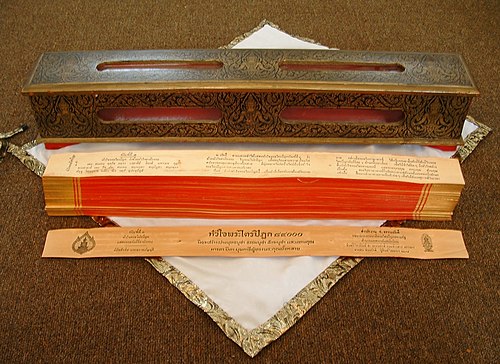
In pre-modern times the Pali Canon was not published in book form, but written on thin slices of wood (called a palm-leaf manuscript) or bamboo. The leaves are kept together by thin sticks, and the scripture is covered in cloth and kept in a box.

Burmese-Pali manuscript copy of the Buddhist text Mahaniddesa, showing three different types of Burmese script, (top) medium square, (centre) round and (bottom) outline round in red lacquer from the inside of one of the gilded covers