Syriac language
Videos
The Syriac language, also known natively in its spoken form in early Syriac literature as Edessan, the Mesopotamian language and Aramaic, is an Eastern Middle Aramaic dialect. Classical Syriac is the
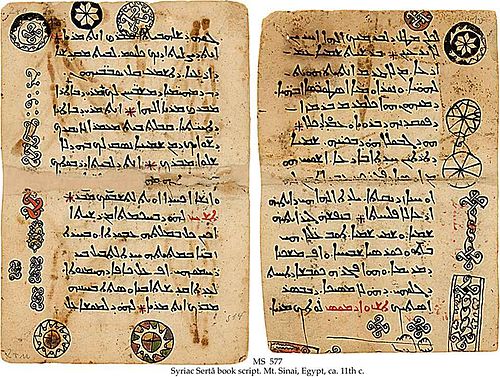
An 11th-century Syriac manuscript

The Syriac alphabet

Late Syriac text, written in Madnhāyā script, from Thrissur, Kerala, India, 1799

An ancient mosaic from Edessa, from the 2nd century AD, with inscriptions in early Edessan Aramaic (Old Syriac)
Assyrians
Videos
Assyrians are a distinct ethnic group native to Mesopotamia with roots in ancient Assyria. They speak varieties of Neo-Aramaic, a branch of the Semitic language family that replaced Akkadian during th
Syriac language
…centuries, but by the end of the Middle Ages it was gradually reduced to liturgical use, since the role of vernacular language among its native largely Assyrian and Aramean speakers was overtaken by several Neo-Aramaic languages. Classical Syriac is written in the Syriac alphabet, a derivation of the Aramaic…

Part of the Lion Hunt of Ashurbanipal, c. 645–635 BC

Mor Mattai Monastery (Dayro d-Mor Mattai) in, Bartella, Nineveh, Iraq. It is recognized as one of the oldest Christian monasteries in existence. It is famous for its magnificent library and a considerable collection of Syriac Christian manuscripts

Masawaiyh, an Assyrian Nestorian physician of the Islamic Golden Age

Mar Elias (Eliya), the Nestorian bishop of the Urmia plain village of Geogtapa, c. 1831