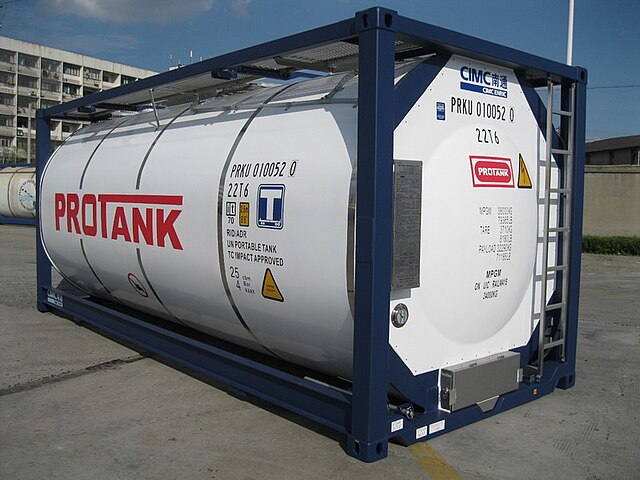
A tank container or tanktainer is an intermodal container for the transport of liquids, gases and powders as bulk cargo. It is built to the ISO standards, making it suitable for different modes of transportation; as such, it is also called an ISO tank. Both hazardous and non-hazardous products can be transported in tank containers.
Universal tank container
Gas containers sometimes have multiple bottles instead of one large tank.
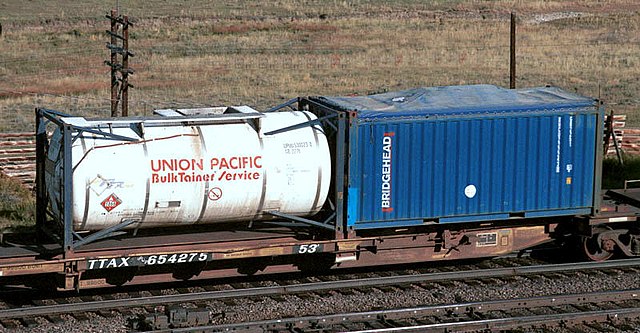
A spine car with a 20-foot tank container (left) and an open-top 20-foot container with canvas cover (right)
Military use of a tank container system.
An intermodal container, often called a shipping container, or a freight container, (or simply “container”) is a large standardized container designed and built for intermodal freight transport, meaning these containers can be used across different modes of transport – such as from ships to trains to trucks – without unloading and reloading their cargo. Intermodal containers are primarily used to store and transport materials and products efficiently and securely in the global containerized intermodal freight transport system, but smaller numbers are in regional use as well. It is like a boxcar that does not have wheels. Based on size alone, up to 95% of intermodal containers comply with ISO standards, and can officially be called ISO containers. These containers are known by many names: cargo container, sea container, ocean container, container van or sea van, sea can or C can, or MILVAN, or SEAVAN. The term CONEX (Box) is a technically incorrect carry-over usage of the name of an important predecessor of the ISO containers: the much smaller steel CONEX boxes used by the U.S. Army.

A 40-foot-long (12.2 m) shipping container. Each of its eight corners has an essential corner casting for hoisting, stacking, and securing
Containers stacked on a large ship.
Transferring freight containers on the London, Midland and Scottish Railway (LMS; 1928)
Freight car in railway museum Bochum-Dahlhausen, showing four different UIC-590 pa-containers